

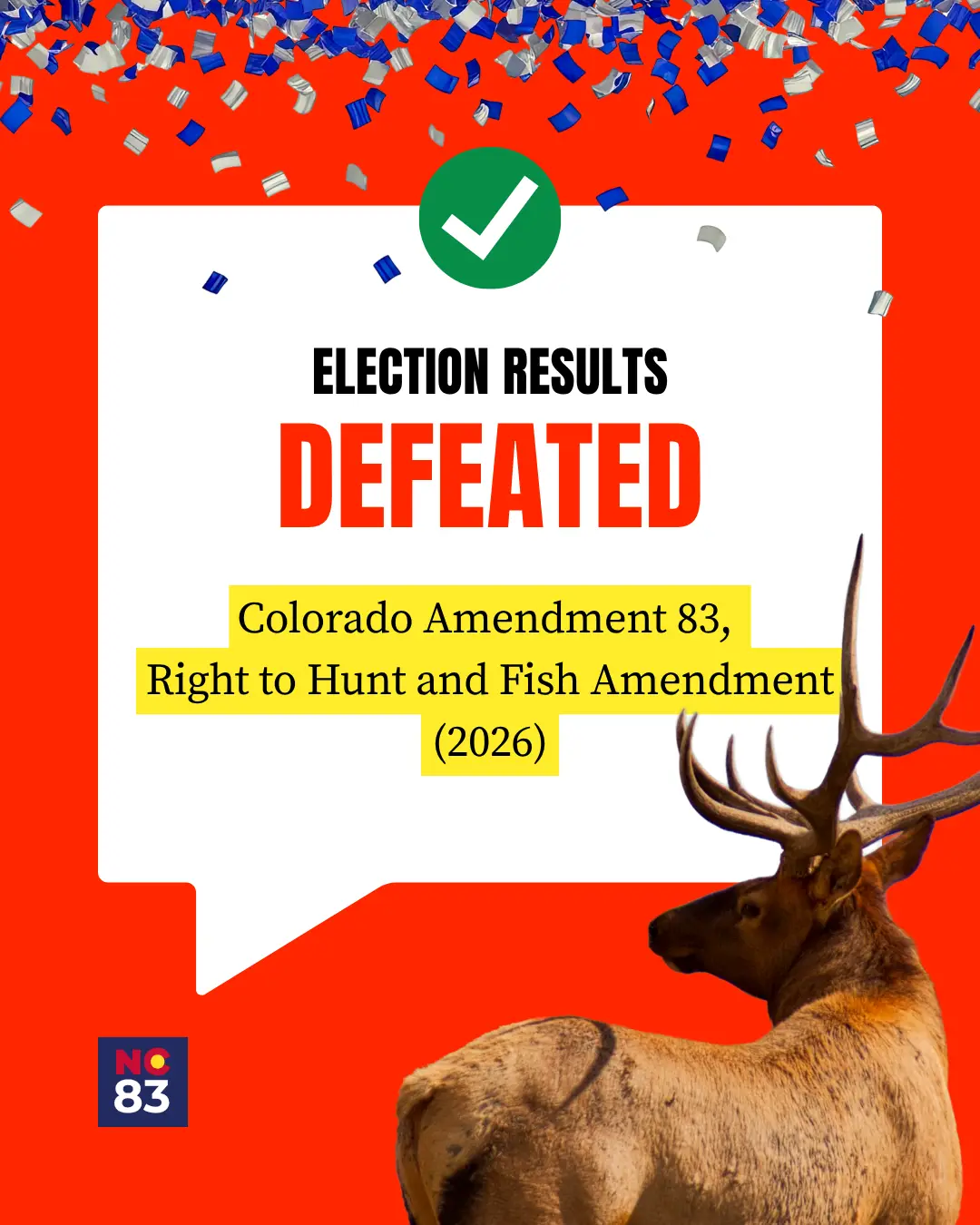
Cheers to Coloradans, who are projected to reject Amendment 83, Colorado’s so-called “right to hunt and fish” ballot initiative.
“We are thrilled that Coloradans showed up for wildlife. Voters stood up for responsible management that protects healthy wildlife and thriving ecosystems,” said Jennifer Best, Director of Friends of Animals’ Wildlife Law Program.
FoA rallied its Colorado members, urging them to vote no, and educating them on the hidden horrors of this seemingly straightforward bill.
Hunters, anglers, and out-of-state trophy-hunting groups tried to convince Colorado’s voters to enshrine hunting and fishing as a constitutional right, as if these lame practices are even under threat in the first place.
Hunting and fishing are already legal in Colorado; the real motive behind this ballot initiative was to recognize hunting and fishing as the “preferred means of managing wildlife,” and to guarantee “traditional methods” of hunting and fishing.
So, instead of prioritizing methods like habitat restoration, vague methods of hunting would have been “preferred.”
“Traditional methods” was also intentionally vague. Traditional methods of hunting could’ve been interpreted as including the use of leg hold traps, steel jaw traps, and bear baiting, all things that Colorado has banned in the past.
This was a part of a national playbook backed by major trophy hunting groups including the Wisconsin-based International Order of T. Roosevelt and Safari Club International.
In Wisconsin, in 2021, following the delisting of grey wolves, a hunting group sued the state, pointing towards WI’s constitutional right to hunt, forcing a wolf hunt. In fewer than three days, hunters killed 216 wolves, 99 more allocated, legally.
Over a third of Wisconsin’s wolves were lost.
Hats off to you, Colorado members. Colorado doesn’t need a “right” to hunt or for hunters’ bloodthirst to take precedent over coexistence, habitat protection, and other solutions suited to keep the animals involved.
Your no vote keeps these choices open!