

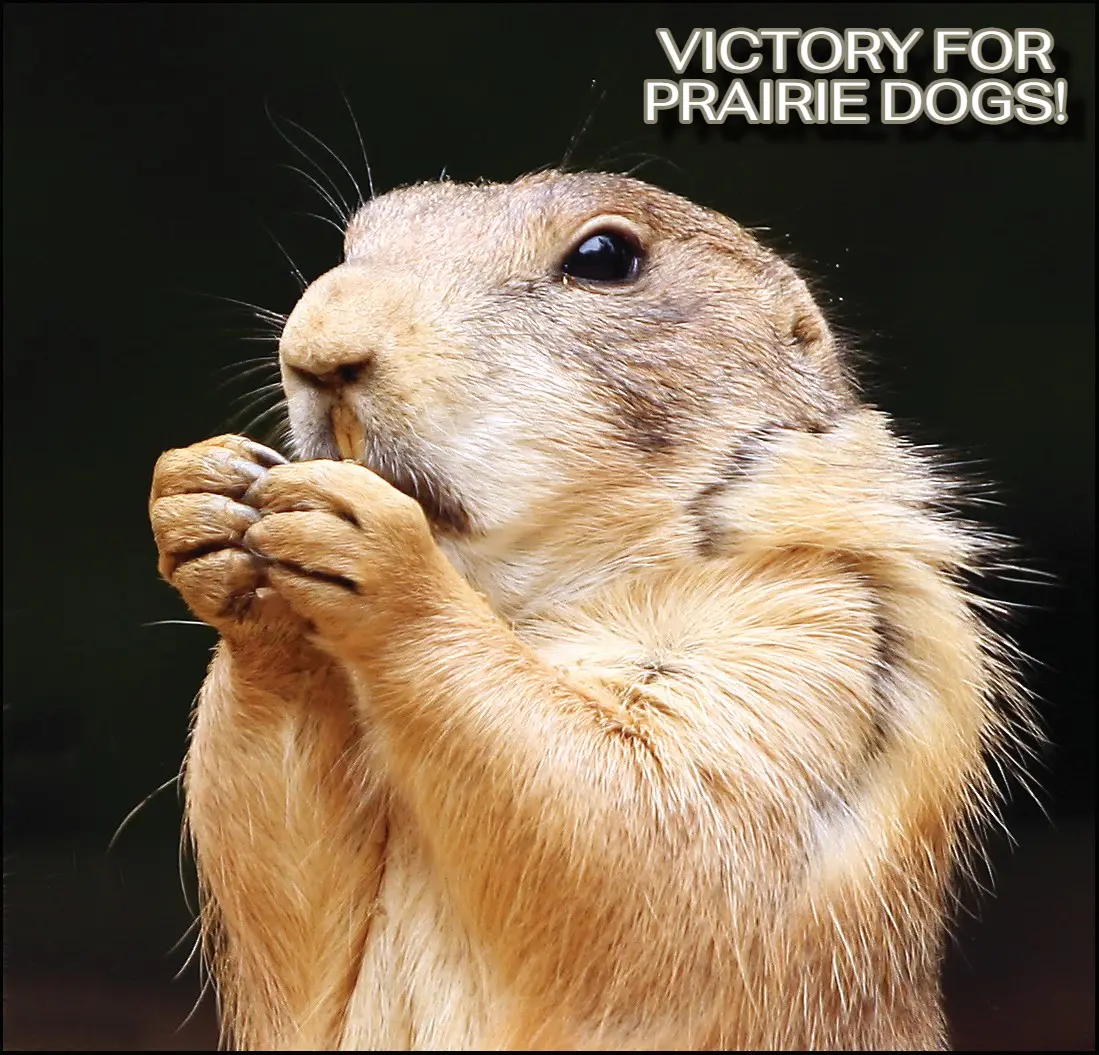
In January, Friends of Animals went to court to defend Utah’s prairie dogs, and on Aug. 12 a panel of Tenth Circuit judges unanimously awarded us a victory!
Our lawsuit against the U.S. Fish and Wildlife Service challenged the agency’s April 2018 decision to issue a range-wide habitat conservation plan without necessary safeguards to protect the prairie dogs, which were declared an endangered species in 1973 after their population dropped to a few thousand. The reckless decision would have allowed for more than 7,000 prairie dogs to be removed or killed over a 10-year period, and allowed for the permanent destruction of 1,750 acres of their occupied habitat.
This case involved tension between the relentless local drive for development and preservation of an animal species threatened with extinction.
“This is an important victory for the Utah prairie dog and for endangered and threatened species nationwide. Every acre of habitat matters for a species already struggling to survive,” said Andreia Marcuccio, senior associate attorney for Friends of Animals. “The decision makes it clear that the government cannot simply assume that mitigation will work. The government cannot just destroy habitat first and figure out the consequences later. The government has a responsibility to understand the harm it causes and take meaningful steps to prevent it.
“You cannot save a species by simply moving it out of the way of the bulldozers. Real conservation means protecting the places they need to survive.”
Utah prairie dogs are a keystone species threatened with extinction as urban development continues to consume their habitat. Congress enacted the Endangered Species Act to stop species like the Utah prairie dog from disappearing, declaring that the conservation of imperiled wildlife must be afforded the highest of priorities. But the U.S. Fish and Wildlife Service did the opposite.
The Tenth Circuit found that FWS’s approval of the plan and related permits violated the Endangered Species Act and the National Environmental Policy Act by assuming that simply moving prairie dogs to other locations would fully mitigate the destruction of their habitat. The court found that the agency failed to compare the biological value of the habitat being destroyed with the habitat where the prairie dogs would be relocated and overlooked the loss of important habitat.
The court also rejected FWS’s conclusion that the plan and related permits would not jeopardize Utah prairie dogs’ survival and recovery because the agency failed to account for the biological value of the habitat being destroyed, and thus it could not adequately determine that the action would not jeopardize the species.
Prairie dogs, which are found only in North America and are social animals, play a significant role in the biological diversity of ecosystems. They fertilize and aerate soil, reducing noxious weeds and help create more nutrient-rich grass for other animals. More than 100 species benefit directly from prairie dog habitats including bison, antelope, mice, burrowing owls and predators such as golden eagles, rattlesnakes, bobcats, badgers, coyotes, foxes and ferrets. But humans have continually pushed into their ecosystem, targeting their population for extinction through poison, shooting and habitat destruction.
“FWS neglected to see the moral and scientific value of seeing these social, intelligent animals as a benefit to western grassland ecosystems, or worthy of our affection and protection. We were not about to give anyone a green light to drive these animals to extinction,” said Priscilla Feral, president of Friends of Animals.