

By Nicole Rivard
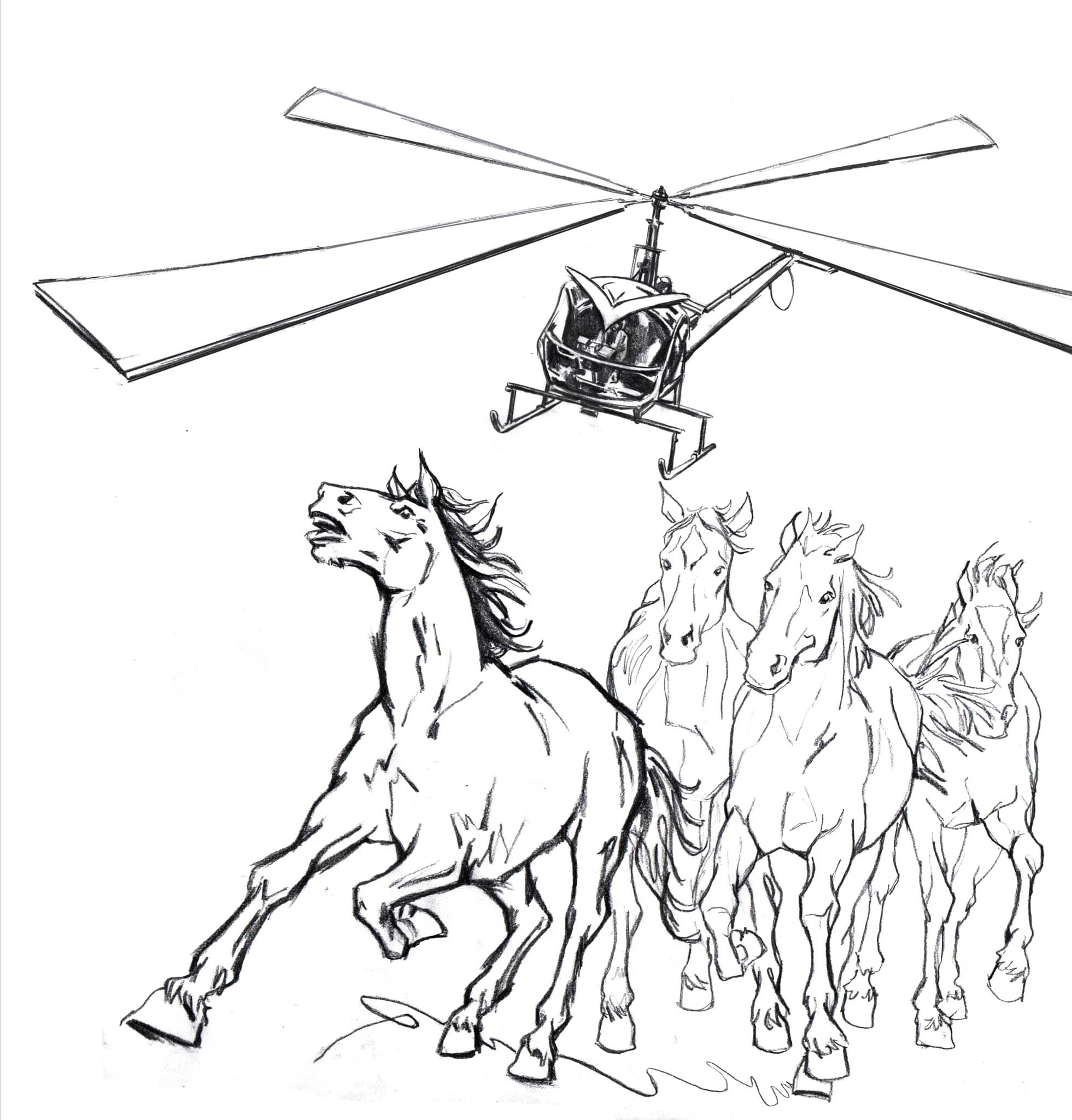
Illustration by Marcus Pierno
One of the things we at Friends of Animals get emailed the most about is the plight of America’s wild horses and what we are doing to protect them.
We weren’t surprised that supporters reached out to us over the summer when a video surfaced of a wild horse collapsed on the ground during a helicopter roundup in the Blue Wing Complex of Nevada. The footage showed a federal worker kicking the horse in the face while it was restrained.
That horse survived, but 42 others didn’t. They died from traumatic injuries such as broken necks and blunt-force trauma as well as non-life-threatening conditions such as blindness, arthritis and clubbed feet for which the Bureau of Land Management routinely kills animals.
Like you, we are devastated, outraged and disgusted. Every time we hear about another barbaric roundup, which dooms wild horses to a life in holding prisons, exploitation or slaughter, it’s gut-wrenching.
But, rest assured, we are not defeated.
In 2025 we will continue to confront the BLM so that the worst government agency does not get away with making decisions based on pressure from the meat industry and others who profit from exploiting public lands.
With a new administration, we will press for an overhaul of the Department of the Interior, because for more than two decades, leadership has betrayed America’s wild horses. We welcome working with officials and members of Congress who will stop allowing BLM to vilify wild horses as an abundant population damaging public lands when the culprits are the meat industry’s doomed cattle and sheep.
BLM’s Big Lie—which FoA has been aware of and protesting for years—was also exposed in a 2024 report by Public Employees for Environmental Responsibility—it revealed that more than two-thirds of BLM acreage is not meeting its own minimum Land Health Standards, due solely to cattle and sheep grazing, while less than 1 percent of those failing acres are due solely to wild horses. In all, 44 million acres of rangelands are failing BLM’s minimum standards, with livestock being the primary cause.
“When it comes to protecting America’s rangelands, BLM suffers from a severe bureaucratic cow blindness,” stated Rocky Mountain PEER Director Chandra Rosenthal.
She noted that an estimated 1.5 million cattle forage BLM lands compared with fewer than 75,000 wild horses. “BLM engages in controversial wild horse roundups, but reductions in cattle herds are rare, regardless of how bad conditions are on the ground,” she said.
We are hopeful FoA’s pivotal work in 2024 can help save more wild horses in the months ahead.
Last spring, U.S. District Court Judge Randolph Moss ruled that the BLM cannot continue to conduct “maintenance” wild horse roundups under its 10-year plans after the agency achieves so-called appropriate management levels—the arbitrary number of wild horses that the agency determines can exist in balance with other public rangeland species, resources and uses in an area.
This victory impacted Utah’s wild horses who call Muddy Creek and Onaqui Mountains home as well as those in Nevada who roam the Pine Nut Mountains and Eagle Complex.
“Although Congress vested the BLM with broad discretion, it also took steps to ensure that the agency based its decisions on accurate information and science, rather than pressure from interest groups or guesswork,” Moss said.
We were optimistic this victory could mean an end to all BLM’s long-term decisions where it rounds up wild horses for 10 years at a time without taking public comment or examining the latest data.
And we saw our hopes come to fruition in a more recent lawsuit we filed in June against the BLM to save hundreds of wild horses from being ripped from their families and home on the range in California’s Twin Peak Herd Management Area during a roundup that was slated for September.
During a preliminary hearing, a judge ruled that BLM cannot gather any animals from 3 of the 5 home ranges in the Twin Peak HMA—the Dry Valley Rim, Observation South or Twin Peaks North—during the gather contemplated by the 2024 Decision Record.
“That is a win for the wild horses and burros in those areas,” said Jennifer Best, director of FoA’s Wildlife Law Program. “And it was based in part on our 10-years plan case finding that BLM can’t just keep going back and rounding up horses under the same decision if it already achieved AML. In these home ranges, the population was within AML after BLM finished the 2022 roundup.”
At press time, we were still proceeding with our preliminary injunction and lawsuit to stop the September roundup of other wild horses in the other two home ranges in the Twin Peak HMA.
In the meantime, we were bolstered by the fact the judge was hearing things she otherwise wouldn’t hear. The judge was so uneasy about the BLM’s ominous plan for Twin Peaks that she ordered agency officials to make themselves available for in-person meetings with FoA.
“We took pleasure in knowing how miserable the BLM decision makers were that they had to meet with FoA and not just be allowed to proceed with business as usual,” said Priscilla Feral, president of Friends of Animals.
During the first meeting, BLM staff made some damning admissions—including that they don’t have good monitoring techniques to distinguish the impact wild horses and burros have on the range from the impact cattle and sheep have.
“The value of being a thorn in BLM’s side is that they know we are watching. There are going to be actions they now never take because they know we won’t sit by and allow them to happen,” Feral added.
There’s also value in appealing a bad decision from the Court. That’s why FoA is appealing a judge’s decision in our lawsuit to halt the construction of the largest off-range wild horse corral in Winnemucca, Nevada.
“The decision overlooks major flaws in BLM’s National Environmental Protect Act analysis and evidence that conditions at this facility are in fact inhumane,” Best explained.
BLM claims it’s following the “standard operation procedures” they have in place for roundups and holding facilities. But the elephant in the room is these step-by-step instructions have never been vetted for public comment or open for experts to weigh in.
“That’s a big part of the Winnemucca case and why we are pursuing it. If we win, BLM won’t be able to rely on these informal operating procedures to claim what they are doing is humane when there are really no teeth to the standard operation procedures when it comes to the well-being of wild horses,” Best said.
“We are trying to change the overall trajectory of the BLM and make it so advocates have a voice. Our goal is to ensure BLM is not doing whatever it wants when it wants—like caving into ranch industry requests—rather than protecting wild horses so they aren’t managed to extinction.”