

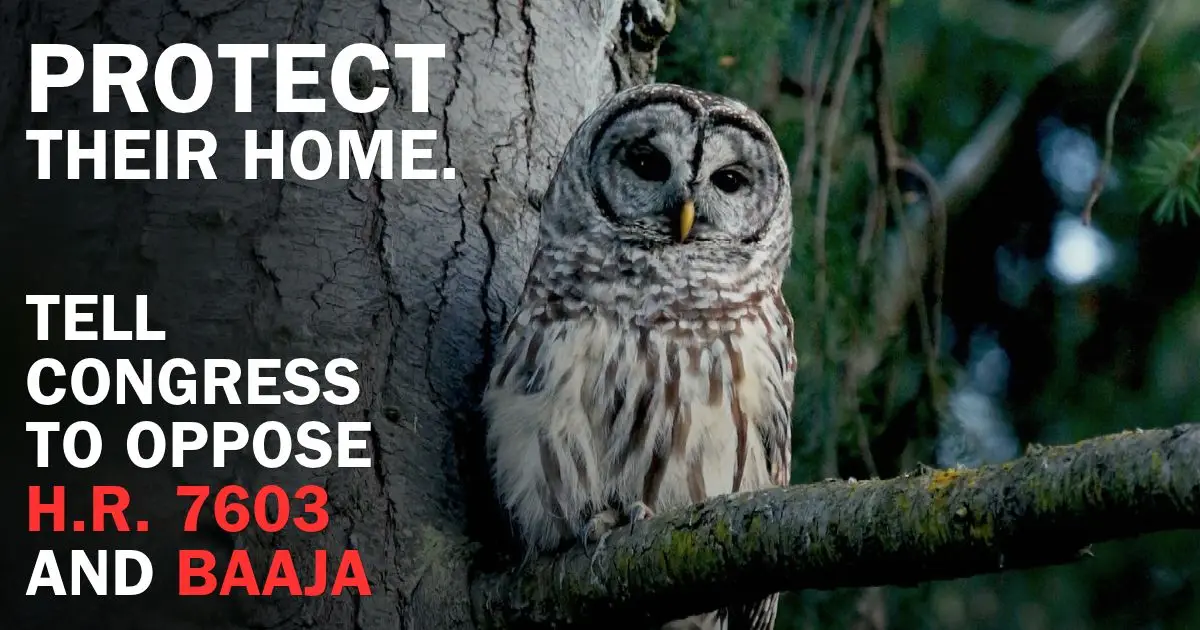
Please press Congress to OPPOSE two bills that puts wildlife and the environment in harm’s way.
FoA sent letters to Congress on Nov. 11 opposing H.R. 7603, the O&C Renewal Act, which would give a preference to logging over all else on certain BLM lands in western Oregon, covering old growth forests, and the Bipartisan American Affordability and Jobs Act of 2026 (BAAJA). BAAJA would fundamentally undermine two of our nation’s most important environmental laws—the National Environmental Policy Act and the Endangered Species Act—and severely weaken the federal government’s ability to protect our nation’s natural resources, wildlife, and public lands.
You can find your U.S. Senators and Representatives here: https://www.congress.gov/members/find-your-member. Please ask them to oppose these irresponsible bills.
WHY THIS MATTERS
• The O & C Renewal Act threatens more than 2.5 million acres of Western Oregon forests that provide essential habitat for coho salmon, marbled murrelets, northern spotted owls, and other imperiled wildlife already struggling to survive. It would open vast areas to the same type of unsustainable logging and clearcutting that pushed these species toward extinction in the first place. These areas serve as critical connectivity corridors that link wildlife habitat.
• These forests contain some of the state’s oldest trees and most fire resilient ecosystems. Old-growth forests capture and store substantial amounts of carbon and are amongst the most significant bulwarks against the increasingly severe impacts of the climate crisis. They also protect watersheds and provide clean drinking water to Western Oregon communities.
• About NEPA, BAAJA would dramatically narrow the scope of projects subject to environmental review, potentially excluding projects with significant environmental consequences, including the destruction of essential wetlands and other critical natural resources.
• Regarding the ESA, BAAJA would allow the state in which a project is located to serve as the consulting agency in place of the U.S. Fish and Wildlife Service or National Marine Fisheries Service. It would also allow agencies to deny necessary protections not because threats have been disproven, but because insufficient information remains to establish them. In effect, the legislation could reward the absence of scientific information rather than encourage the precaution necessary to protect imperiled species and their habitats.