

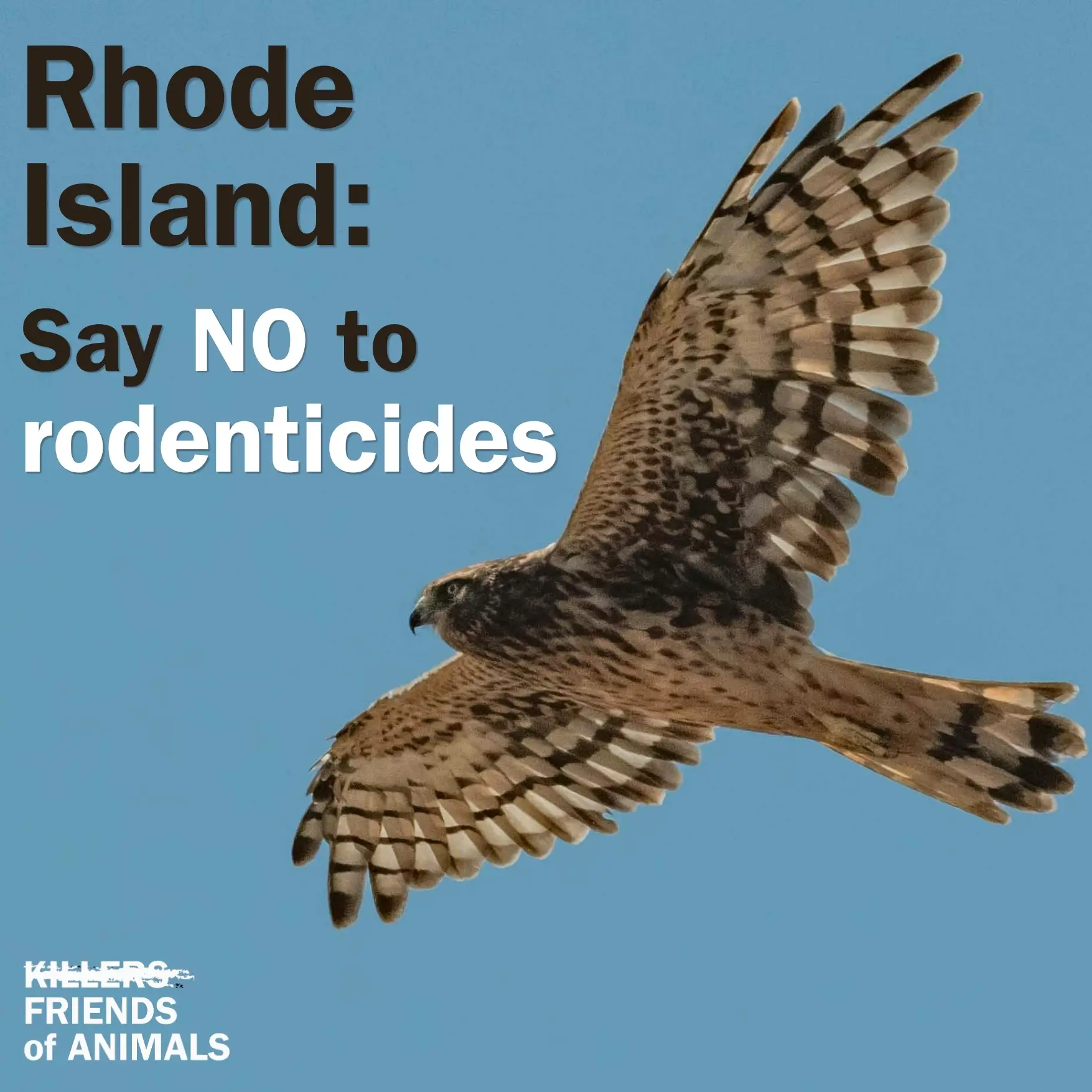
Legislation championed by Sen. Melissa Murray and Rep. Rebecca Kislak that would ban first- and second-generation anticoagulant rodenticides statewide in Rhode Island — even for pest control companies— by Jan. 1, 2029, cleared both chambers of the RI General Assembly last week and is on its way to Gov. Daniel McKee’s desk.
Like in CT, where FoA is working tirelessly to ban the sale of use of anticoagulants, raptors and mammals in RI are under siege from these powerful, long-lasting poisons making their way up the food chain. Anticoagulants work by preventing blood from clotting. So, hawks, eagles, owls and other wildlife are dying a slow agonizing death from internal bleeding after consuming poisoned rodents who’ve taken the bait from those ubiquitous black boxes you see outside grocery stores, around housing developments and town parks.
This is time-sensitive, so please call or write to the governor immediately and tell him to sign the bill (SB2795/HB7222) into law. You can call his office: (401) 222-2080 or use this contact form: https://governor.ri.gov/contact.
It has come to our attention that the New England Pest Management Association is livid about this legislation and has launched a so-called “VoterVoice” advocacy campaign urging Gov. McKee to veto the bill. NEPMA wants the will of the people squashed. We can’t let big industry/lobbying interests win over RI’s beloved wildlife.
Should the legislation become law, first-generation anticoagulants would be banned for consumer sales in Rhode Island starting March 1, 2027. An explicit ban on newer, more potent second-generation anticoagulants — which were developed starting in the 1970s and are registered only for use by pest professionals — would be codified in state law starting Jan. 1, 2028.
By Jan. 1, 2029, both first- and second-generation anticoagulant rodenticides would be banned statewide — even for pest control companies, albeit with some exceptions for use in public health, agriculture, food production, and certain types of facilities.
“Unfortunately, not only do rat poisons kill the natural predators of rats, many rats have developed resistance to them, so they are ineffective on top of being dangerous and counterproductive. Accordingly, many communities are losing the battle against them. We need to change our tactics,” said Representative Kislak (D-Dist. 4, Providence). “This bill establishes a new approach through a pilot program of modern integrated management that addresses the problem in a variety of ways, including stepping up efforts to keep trash and other food sources properly contained, encouraging rats’ natural predators and using newer products that prevent rats from reproducing. We’ll use what we learn from the pilot program to guide our approach statewide in the future.”