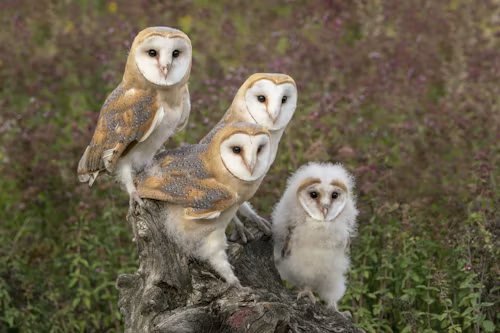
Like the rest of the world, we at Friends of Animals have been captivated by the barn owl family—two adults and five fledglings— who at the end of August nested in a water tower atop a building near Central Park on the Upper West Side. While barn owls have been seen in NYC, it’s the first barn owl nest in Manhattan in recorded history, according to the Cornell Lab of Ornithology.
We were gutted when news broke last Thursday that construction workers removed the roof of the water tower, exposing and disturbing the nest and endangering the owl’s lives. The NY Times reported that the juveniles had started to fly recently, but they are still relying on their parents for hunting. Jessica Wilson, executive director of the NYC Bird Alliance, told the paper that deprived of their common spot to congregate in the evenings, the owlets risk missing their parents’ food deliveries.
FoA staff members breathed a collective sigh of relief this morning as all seven barn owls were spotted Sunday night, according to Manhattan Borough President Brad Hoylman-Sigal.
Barn owls are not endangered in New York State, but they are protected under state wildlife laws, and it is illegal to destroy an active nest. Such nests also are protected under the federal Migratory Bird Treaty Act. Destruction of an active nest is illegal. Like Hoylman-Sigal, FoA wants the landlord to be held to accountable for breaking the law. A violation of the Act is a misdemeanor with maximum $15,000 fine and/or imprisonment for not more than six months.
This heartbreaking incident provides a teachable moment whether you’re a landlord in NYC or someone who resides in the countryside: every owl is essential. And so are their homes.
It’s not about us. They help keep rodent populations in check, and they’re part of Nature, which benefits the ecology. Let them be.
“These owls are protected for a reason. They are living beings, an essential part of a broader ecosystem, and a source of joy and wonder for those lucky enough to catch a glimpse of them,” said Jennifer Best, director of Friends of Animals’ Wildlife Law Program. “We must respect their place in the wild.”
When humans disregard how their actions affect migratory birds, the consequences can be permanent: too many species have already been lost to extinction or treated like their lives were throw-away.
Everyone glued to what’s happening with the barn owls in NYC should think about protecting owls in their own communities.
All too often barn and screech owl nests are lost to reckless tree cutting. We’ll never forget the adult saw-whet owl who had to be rescued in 2020 from the 75-foot Norway spruce that would become the Rockefeller Center Christmas Tree. She had luckily survived the 170-mile trip from Oneonta in upstate New York to New York City.
Besides habitat protection, people need to stop using second-generation anticoagulant rodenticides, which contributed to the deaths of other raptors in NYC who had achieved celebrity status—Flaco the Eurasian eagle-owl who flew around Manhattan after someone let him out of his zoo enclosure, and Central Park’s Barry the barred owl.
As we continue to monitor what happens to these barn owls and admire their resiliency, we are grateful to the legislators, wildlife rehabbers, and concerned residents who have their backs.
It was Elisabeth Williams, an Upper West Side resident, and her husband who notified a local news outlet about the multiple owls at the water tower in the first place.
Williams told the media that she and her husband were not bird watchers before the barn owl family moved into the water tower near their apartment. But that may change after their “delightful” experience.
“I think we’re about to become birders,” Williams said.
Rare NYC barn owl family is every owl
Published in News on November 2, 2026