

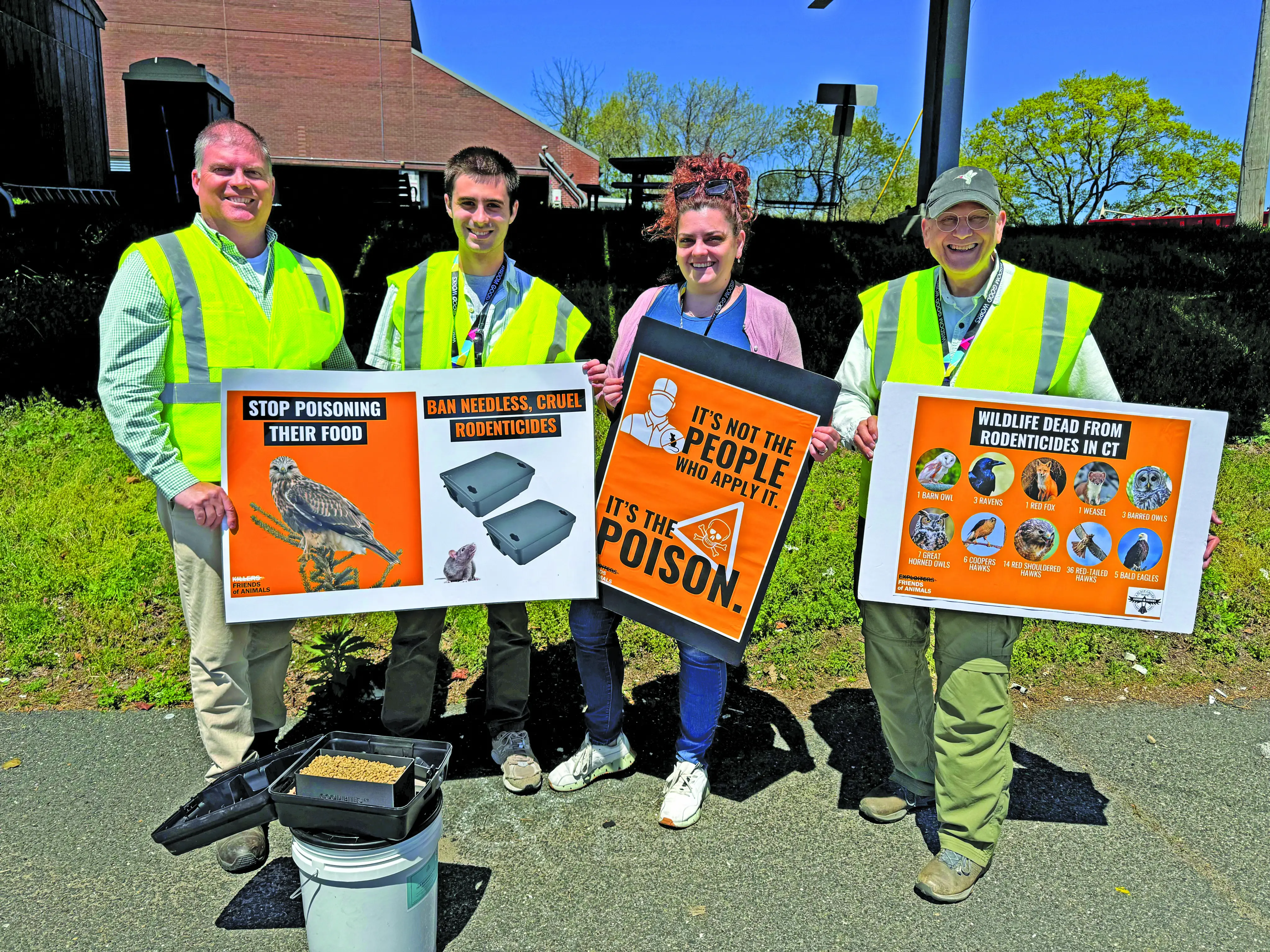
Friends of Animals has some positive updates from the field!
We are nine months into the year-long pilot program that we helped launch in Fairfield, Connecticut, to tackle rodents. In the two locations the town has targeted— the Transfer Station and the compactor behind the Fairfield Theatre Company, they’re using plant-based peanut butter contraceptive pellets, created by the nonprofit WISDOM Good Works, instead of second-generation anticoagulant rodenticides (SGARS).
The switch has not resulted in more rodents. In fact, pellet consumption has gone down, indicating animal population has gone down, according to Alaina Gonzalez-White, WISDOM Good Works director of operations. While a full report will be provided by Wisdom Good Works in the spring, this is cause for celebration!
Raptors such as hawks, owls, eagles, and other mammals are under siege from SGARS, powerful, long-lasting poisons making their way up the food chain. Anticoagulants work by preventing blood from clotting. So, animals are dying a slow agonizing death from internal bleeding after consuming poisoned rodents who’ve taken the bait from those ubiquitous black boxes you see outside grocery stores, around housing developments and town parks.
What the WISDOM Good Works team will be looking for in the upcoming weeks is whether or not they can suppress the anticipated spring rodent population spike.
“Normally the animals tend to come out of their more dormant season and reproduction ramps up,” explained Gonzalez-White. “If we can hold the line through the spring, that’s a huge win.”
WISDOM Good Works has already achieved success with other pilot programs across the country in a wide range of settings.
“To measure the impact on a particular site you must consider whether the perimeter is open or closed. For example, if you are working in a completely sealed building as we were in an animal sanctuary in Utah, we were able to measure a sustained 98% mouse population reduction within three months,” Gonzalez-White said.
In the outdoor urban setting of the Jamaica Plain neighborhood in Boston, she had to take into consideration that there would be immigration—rats don’t observe property lines.
“In this open area we were still able to reduce the population by a sustained 56% within five months and 72% at month 10.”
She explained that reducing by 50-60% is really where a balance is found, when there is no longer human wildlife conflict. In other words, rodents are no longer a nuisance, they are no longer getting into your garbage cans—at that point it can really be a reduction that can be claimed as a win.
The contraceptive pellets consist of peanut butter, corn meal, wheat flour, rice flour, oats, table sugar, and root powder from the Thunder God Vine. The active ingredients of the Thunder God Vine prevent sperm maturation and fertility as well as ovarian egg development and ovulation. The active ingredients act quickly and, in a few weeks, individual mice or rat’s fertility has ceased. Then, in a few months, enough individuals in the population are infertile to reduce the population size. They must keep eating the pellets to stay infertile.