

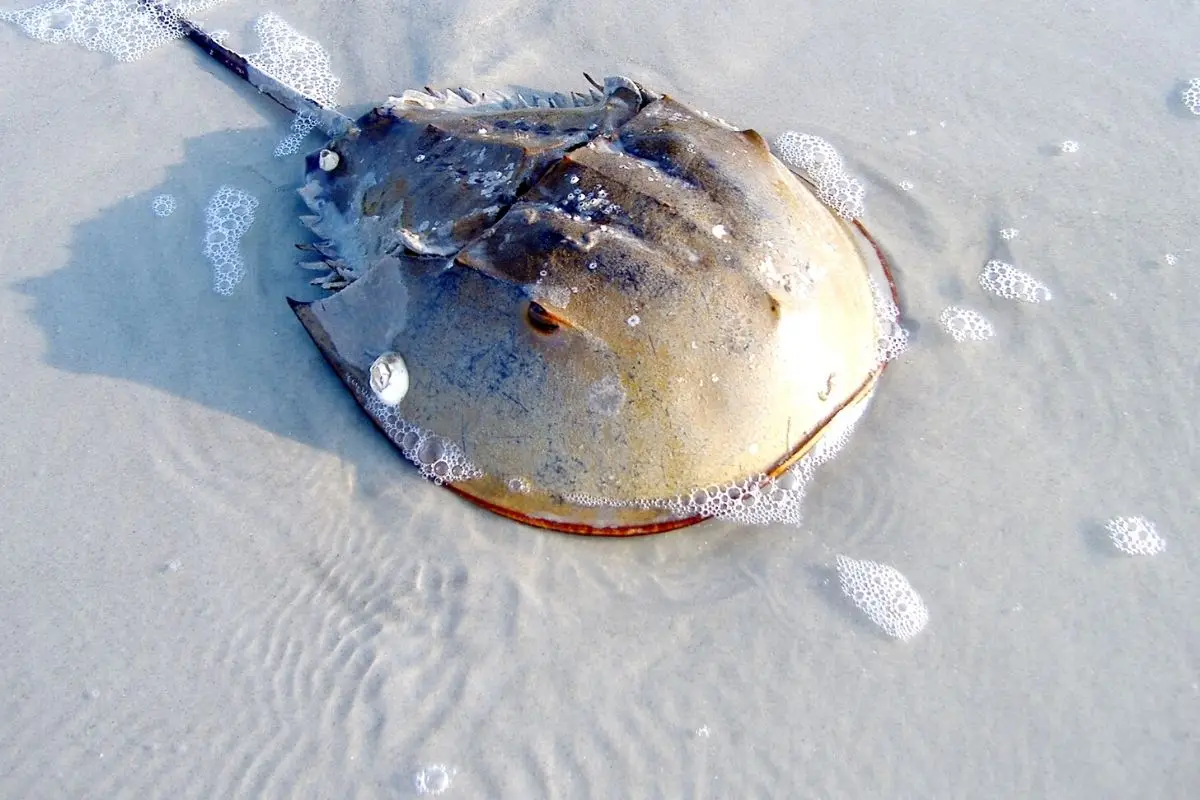
New York Gov. Kathy Hochul has signed a bill that prohibits the hand capture and killing of horseshoe crabs from the waters and shoreline of the state. Under the new law, the killing of horseshoe crabs for commercial or biomedical purposes will be phased out over a three-year transition period (the quota will go down 25% each year), with the full prohibition taking effect beginning in 2029.
Friends of Animals brought the plight of horseshoe crabs to the attention of NY Assemblymember Deborah Glick—who knows the Fire Island shore well, which is among the prime habitats for horseshoe crabs—and helped advocate for the legislation when she introduced it.
We also led the charge to get a similar ban passed in Connecticut in 2023.
“Hope has arrived. Finally, New York, like Connecticut, is drawing a line in the sand to stop the seasonal killing of horseshoe crabs,” said Priscilla Feral, president of Friends of Animals. “NY’s quota for chopping up horseshoe crabs only to bait eel and whelk pots is a staggering 150,000 horseshoe crabs. The success of this legislation ends this wasteful carnage and gives horseshoe crabs a fighting chance to recover from decades of exploitation.”
Horseshoe crabs are already functionally extinct in Long Island Sound, which means they no longer play an effective role in their ecosystem, and NY needed to stop the reckless, unnecessary killing of horseshoe crabs for bait so people could eat smoked eel and conch fritters. The Atlantic Marine Fisheries Commission downgraded the stocks of horseshoe crabs in the NY region, which includes Connecticut and the Long Island Sound, from Neutral to Poor in 2019.
“Horseshoe crabs have survived mass extinctions and dramatic changes to our planet, but they are now struggling to survive the impacts of human activity,” said Assemblymember Glick. She pointed out that the killing of horseshoe crabs for bait and biomedical use has pushed this ancient species into decline, with ripple effects being felt throughout coastal ecosystems.
“By signing this legislation into law, New York is taking decisive action to protect a living fossil and the many species that depend on it,” Glick said. “This could not have been accomplished without the steadfast support and passion from advocates for environmental conservation across the state. I thank Governor Hochul for standing with advocates and the Legislature to protect this critical species.”
“The momentum building at both state and federal levels to protect this keystone species is encouraging,” said Connecticut Deputy House Speaker Joe Gresko, who shepherded Connecticut’s ban on hand harvesting. “This living fossil has assisted us with vaccine purity, now we have to return the favor with preservation.”
Notably, the biomedical industry has no excuse not to stop wasting the lives of horseshoe crabs. May 1 marked a pivotal shift industry that changes the tide for imperiled Atlantic horseshoe crabs. U.S. pharmaceutical companies are now allowed to use animal-free alternatives—the reagents rFC and rCR— in tests to detect toxic substances in injectable medicines and implants rather than the blue blood of the horseshoe crab. The new standard was proposed and adopted by U.S. Pharmacopeia.
These living fossils have survived millions of years, so left alone, we’re confident they will return in numbers. By safeguarding horseshoe crabs, we strengthen our entire ecosystems.
Migratory birds need to eat horseshoe crabs’ eggs, especially the threatened red knot. In 2021, fewer than 7,000 red knots were found in the Delaware Bay, a key spring stopover habitat. That’s less than a third found in 2020. And red knot numbers remained at historically low levels in 2022. New Jersey banned the killing of horseshoe crabs in 2008.
Without sufficient horseshoe crab eggs to feed on, migratory birds run out of energy and die before reaching their breeding grounds. Horseshoe crabs are also an important source of food for other wildlife such as sea turtles, and species such as anemones, barnacles, oysters and seaweed use horseshoe crab shells as homes.
“Horseshoe crabs have figured out how to harmonize with the environment to last half a billion years. Humans can really learn a thing or two from them,” said Feral.