

By Nicole Rivard
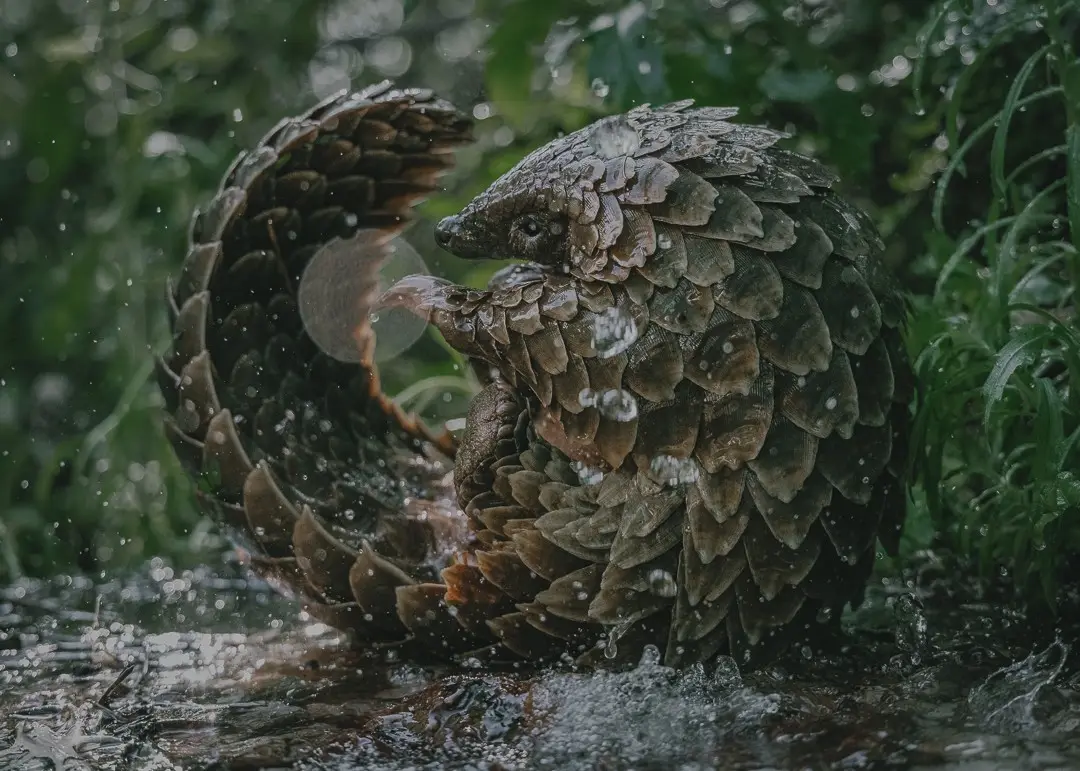
One unforgettable scene in the documentary “Pangolin: Kulu’s Journey” is of the scaly, magical, charismatic little creature having the time of his life rolling around in the mud and fresh dung—a pangolin simply being a pangolin.
The movie was released in the spring on Netflix. It follows Kulu’s journey back to the wild savanna of Lapalala Wilderness Reserve, a four-hour drive from Johannesburg, South Africa, with help from a devoted human guardian—Gareth Thomas—after being rescued from poachers.
Director Pippa Ehrlich, the Oscar-winning director of “My Octopus Teacher,” wanted people to fall in love with pangolins for who they are, not just as victims because they’re the world’s most trafficked mammal and some species are critically endangered, and then feel hopeless and forget about them.
“What struck me about Kulu, was that when he was having a good time, there was absolutely no question about it in your mind; that pangolin was experiencing some form of joy,” Erhlich told Friends of Animals from her home in South Africa. “I think what people really love is watching the joy pangolins have for being alive.”
Ehrlich received an email from Dr. Karthi Martelli, a scientific advisor on the film who is also a wildlife vet based in Hong Kong. She has been working with pangolins for a long time and said, “Thank you for restoring the dignity of these creatures.”
That meant everything to Ehrlich.
“Here are these absolutely special creatures, who have been here for such a long time. They have every right to be here; they belong here with us. And then the idea that they share their world with their only prey—ants and termites—and aardvarks and others; and all those creatures belong here with us too,” she explains.
The timing of the documentary’s release could not be better. In June, the U.S. Fish and Wildlife Service proposed to protect pangolins under the Endangered Species Act, a move that would firmly and finally close any U.S. market in these gravely imperiled animals. Protecting pangolins under the ESA would also send a strong signal to China, which has been hesitant to fully close its own market for pangolin parts.
Friends of Animals will be submitting comments to support the proposal before the Aug. 18 deadline. The public can also submit comments by going to www.regulations.gov, docket number FWS-HQ-ES-2025-0028. FWS will review all comments before publishing a final rule.
Moving people to take action
Working as a filmmaker for the Sea Change Project, a nonprofit environmental storytelling organization comprised of media and science professionals, has influenced Ehrlich’s narrative style. She has described it as “emotional ecology,” which is the idea that in nature you have these incredibly complex webs of life that we’re all part of on a practical, material level—but there is also an emotional connection flowing through the network as well. She stresses that it is emotion that moves people to take action.
If “My Octopus Teacher” is any indication, it is working.
Since it was released in 2020, there has been a global movement to ban octopus farming. In the U.S., octopus farming has been banned in California and Washington.
The movie follows naturalist Craig Foster, co -founder of the Sea Change Project, diving in the kelp forests in the Western Cape of South Africa. During that time, he found a common octopus who began to trust him, and he revisited and filmed her every day for a year.
Now it is time to act for pangolins.
The terrors of trafficking
While the film purposely focuses on Kulu and his world rather than the poaching side of his story, the film starts off showing Kulu being rescued by the African Pangolin Working Group, whose members work tirelessly and risk their lives to combat the illegal wildlife trade.
Co-founder Professor Ray Jansen who is featured in the documentary, has witnessed the scale of this threat firsthand: the zoologist-turned-sting operative helped rescue 301 live pangolins, including Kulu, between 2016 and 2024, leading to the arrest of nearly 700 wildlife traffickers.
Ehrlich wants people to walk away from the film feeling there is hope that pangolins will get stronger protections, that there will be better enforcement of anti-poaching laws and that there will be increased support for rehabilitation efforts.
“There are people—like Gareth, Nikki and Ray from the African Pangolin Working Group—who have dedicated every waking hour of their lives for years to protect these special little creatures. To them each and every individual pangolin is so important,’ Erlich said. “The idea is that if you have healthy population of pangolins on a specific reserve, and they disappear somewhere else, you might be able to relocate them in the future. So, you can have these pangolin life rafts.”