

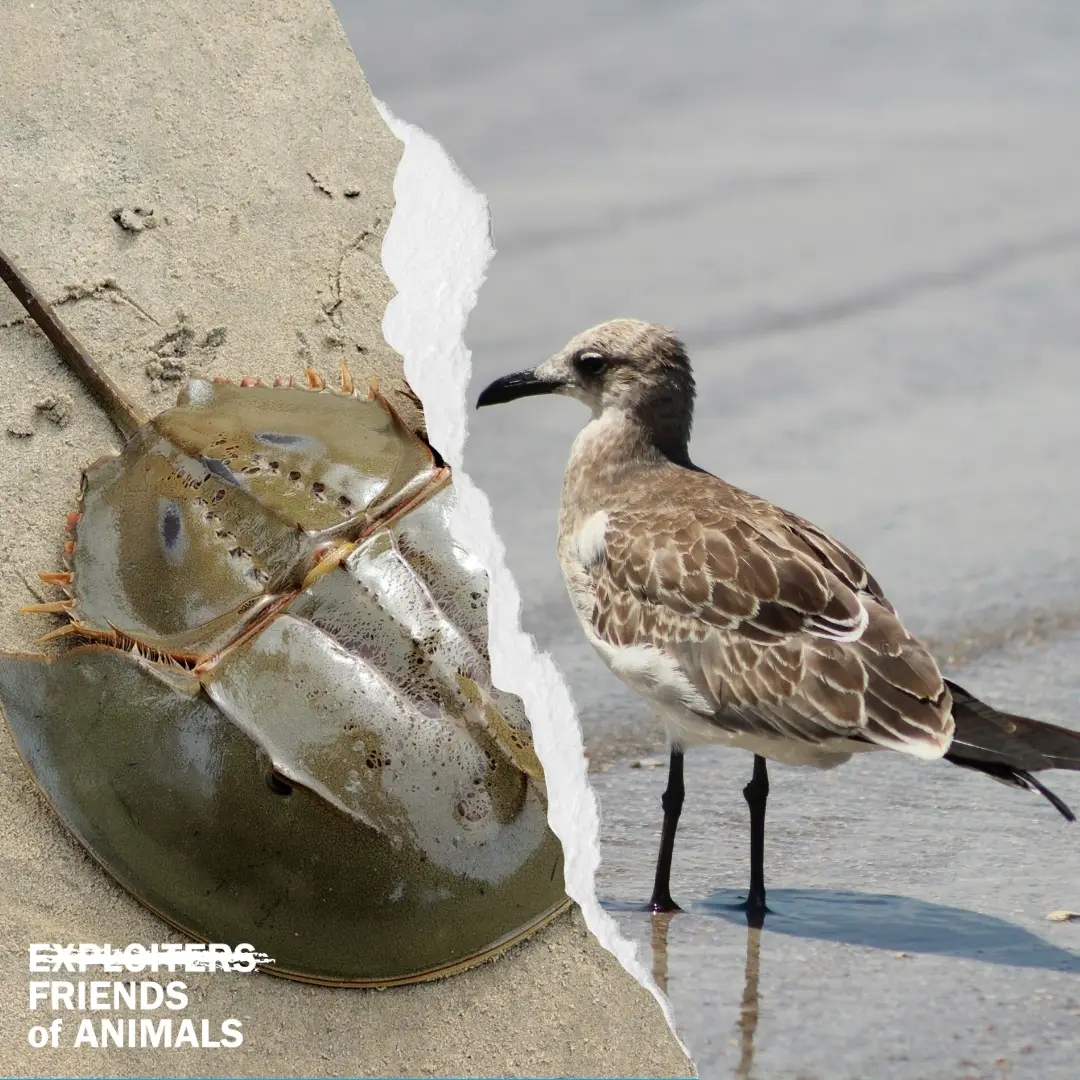
Last week the Atlantic States Marine Fisheries Commission voted to continue a ban on killing female horseshoe crabs for bait in Delaware Bay for another two years.
However, the Commission is still recklessly allowing the killing of 500,000 male horseshoe crabs—which does not bode well for the recovery of the species overall.
Atlantic horseshoe crabs are in such dire straits that Friends of Animals and other advocacy groups have petitioned to list them under the Endangered Species Act. On Sept. 29, Friends of Animals notified the U.S. Secretary of Commerce that it plans to bring a lawsuit if he does not respond in 60 days.
Friends of Animals, which led the charge to get the killing of horseshoe crabs for bait banned in Connecticut, testified last month in support of a similar bill moving through the legislature in Massachusetts. And we are pressing NY Gov. Kathy Hochul to sign into law legislation that would ban the massive killing of horseshoe crabs in New York’s region of Long Island Sound for bait or biomedical purposes.
Horseshoe crabs are connected to the survival of the threatened rufa red knot, as well as dozens of other species, from shorebirds to fish to sea turtles. Threatening one species threatens many more.
Notably, the Delaware Bay is home to the largest population of spawning horseshoe crabs in the world. Spawning primarily occurs from mid-May to mid-June and usually coincides with the full and new moon high tides and is usually more prevalent at night. At the high tides of the full and new moons, female horseshoe crabs come ashore to lay their eggs. Waiting at the tide line, a male grabs hold of the female’s shell.
The female digs a shallow nest in the sand and lays up to 20,000 small, olive-green eggs. Next she drags the male over top to fertilize the eggs. Then they cover the eggs with sand and return to the water.
After two to four weeks, the 1/8 inch-long juvenile crabs hatch, dig to the surface, and head for the water. Feeding on tiny worms, clams and dead fish, the young crabs continue to grow and molt until they reach sexual maturity around 10 years of age. It is believed that they live up to approximately 20 years.
The Delaware River Basin Commission points out that while many eggs hatch, others lay exposed, as the waves at high tide having washed away much of the sand that covered them. And, thousands of miles away another biological clock is ticking.
Red knots, ruddy turnstones, sanderlings, and semi-palmated sandpipers are already in flight, leaving behind their wintering grounds in Central and South America—the mudflats of Surinam, the rocky nooks at Tierra del Fuego, the meadows on the Argentine Pampas.
They’re winging some 7,000 miles towards the bay and the little green eggs that are now crucial to their survival. Depleted of fat reserves on arrival, many birds will almost double their body weight during their two-week stopover along the Delaware Bay.
They then depart on the next leg of their journey—a 2,000-mile, non-stop flight to their Arctic breeding grounds.