

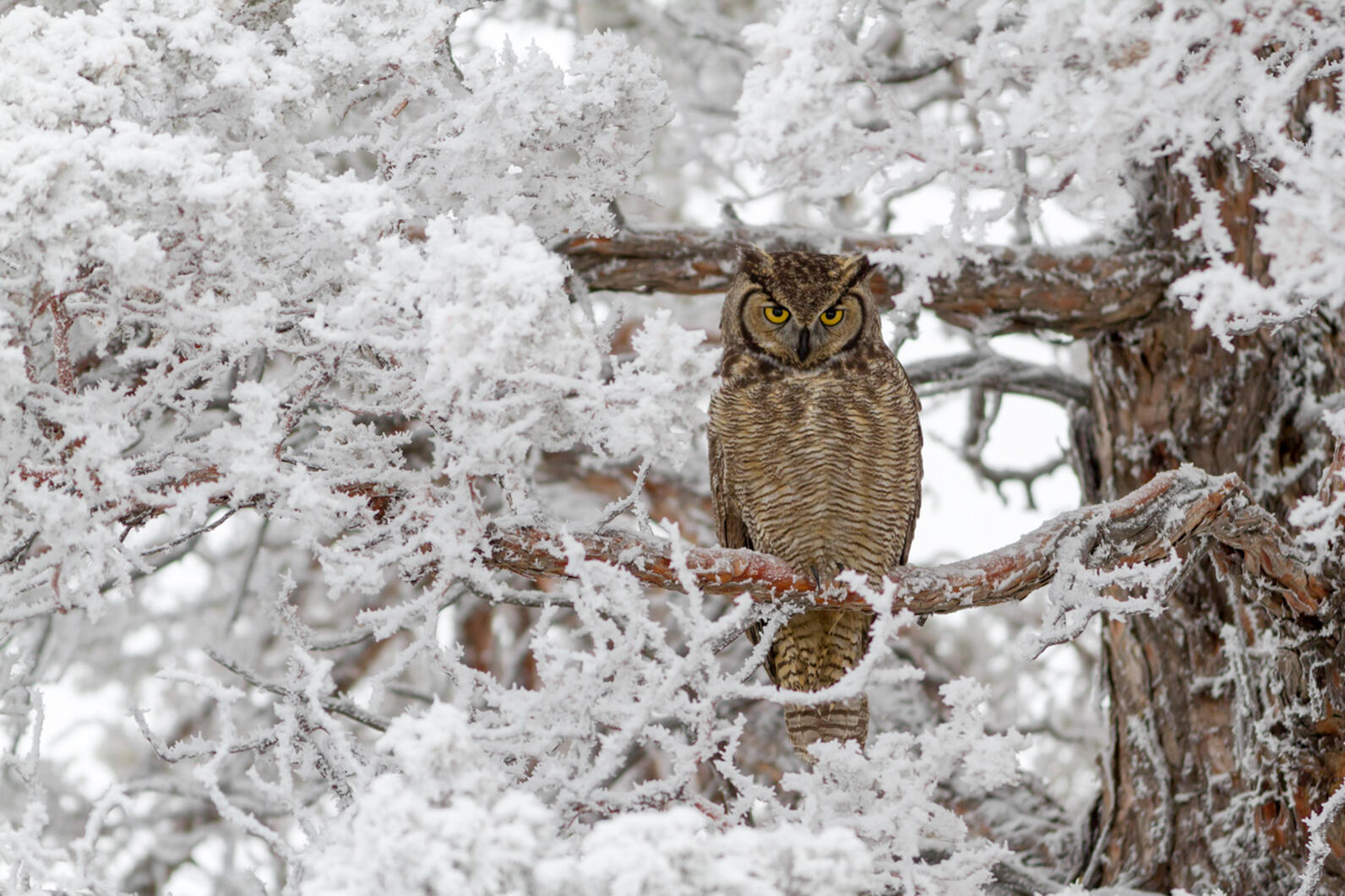
In Connecticut where Friends of Animals is headquartered it’s a frosty 7 degrees. While the recent snowfall we had was beautiful, we’re fantasizing about warmer spring days! But one creature who thrives in this chilly, mid-winter, weather is the great horned owl. They are unfazed by winter, often perching for hours in freezing conditions.
Winter is actually their breeding and nesting season—they are one of the earliest nesters. They court, lay eggs (often in old hawk nests) and nest in late January or February.
Why risk the year’s most severe weather by nesting now? Ornithologists say it’s because great horned owlets, which hatch after a month of incubation, must remain near their parents a long time compared to many other birds — right through summer and into early fall. During this time, young owls learn the skills they need to hunt on their own — before the rigors of the next winter set in.
This adaptive strategy has proven very successful: they are the most widely distributed owl of the Americas. They are the supreme predatory night birds from the northernmost forests of Canada to Tierra del Fuego.
So how do these spectacular owls keep warm? Their soft down feathers trap body heat, keeping them warm in freezing temperatures, while feathered legs and toes protect their feet from cold. They often roost in dense conifers or trees with heavy foliage for camouflage and protection from the elements. Their silent flight, sharp hearing, and superb night vision allow them to hunt effectively for small mammals, birds, and other prey in low light and snowy conditions.
Here are some tips to spotting great horned owls in the winter:
- Listen for Calls: Winter is their hooting season, so listening for their distinctive calls is a great way to find them. They advertise their territories with deep, soft hoots with a stuttering rhythm: hoo-h’HOO-hoo-hoo. The male and female of a breeding pair may perform a duet of alternating calls, with the female’s voice recognizably higher in pitch than the male’s.
- Follow Crows: Crows often harass owls, so if you see crows mobbing a tree, look up; an owl might be hidden nearby.
- Look in Trees: Check large evergreen trees or dense woodlots during the day for roosting owls, whose camouflage makes them hard to spot.