

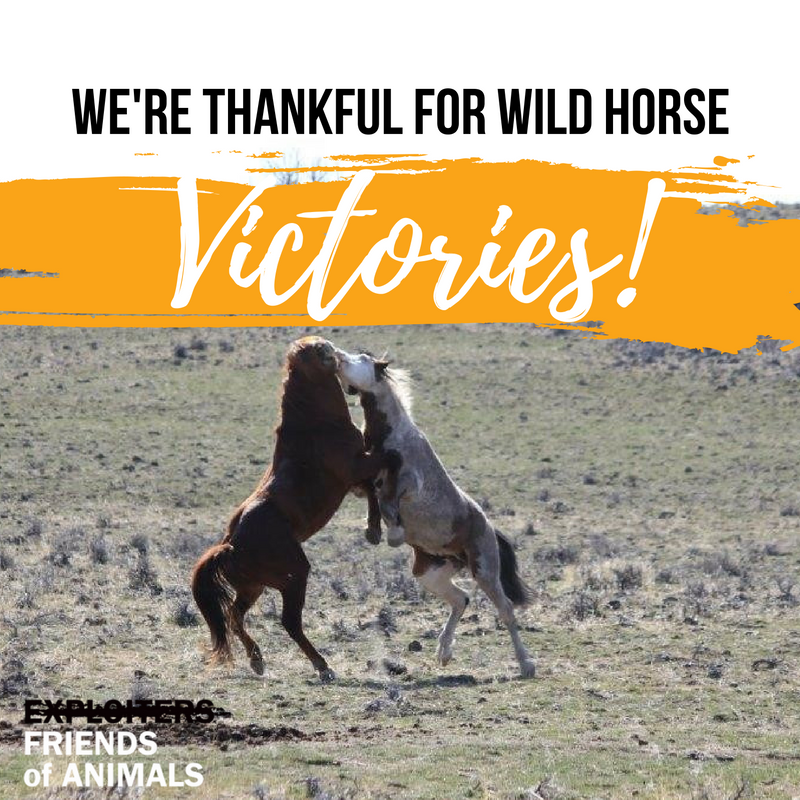
In a stunning victory for Wyoming’s wild horses, the Tenth Circuit has ruled that the Bureau of Land Management did not follow the law in making its decision to zero out wild horses in the state’s Checkerboard, where public lands are interspersed with private parcels like those owned by the Rock Springs Grazing Association (RSGA).
The BLM’s decision, an attempt to appease the meat industry, specifically the RSGA, would have eliminated wild horses from more than one million acres of federal public lands in the southwestern part of the state. Specifically, it would have eliminated the wild horse populations in the Salt Wells Creek and Great Divide Basin herd management areas and gutted their numbers in the Adobe Town HMA.
“This ruling is a major victory for America’s wild horses and a critical check on the Bureau of Land Management’s authority,” said Jennifer Best, director of FoA’s Wildlife Law Program. “The Tenth Circuit Court of Appeal rightly held that BLM cannot sidestep its legal obligation to manage wild horses as part of a thriving natural ecological balance.”
FoA is still waiting for how BLM will respond to the ruling. If BLM doesn’t voluntarily suspend the Adobe Town and Salt Wells Creek roundups slated to begin Aug. 25, FoA plans to fight those efforts.
The court found that BLM acted “arbitrary and capricious” in its failure to attempt to manage wild horses in a manner that achieves a thriving ecological balance.
BLM claims there are an estimated 2,755 wild horses in the removal area.
Adding insult to injury is that at least 14,448 cattle and 40,231 sheep are allowed to graze where the BLM wanted to wipe out wild horses.
The lawsuit points out that nothing in the Wild Horse and Burro Act of 1971 allows BLM to respond to removal requests from private landowners by removing wild horses from public lands and treating public lands as private lands.
“Eliminating wild horses from public lands in this area to appease private grazing interests is not only unlawful—it undermines the very purpose of the Wild Free-Roaming Horses and Burros Act. This decision reinforces that wild horses have a rightful place on our public lands,” Best said.