

After the recent election landslide in Connecticut, where Friends of Animals is headquartered, we are preparing to lead efforts in the state to ban the sale and use of second-generation anticoagulants (brodifacoum, bromodialone, difenacoum and difethialone) with limited exemptions during the 2027 legislative session, which runs Jan. 6-June 9.
The legislation that we will get reintroduced will reduce unnecessary rodenticide use by requiring individuals and businesses to focus on less toxic methods of pest control and removing food sources. Connecticut would become the third state to ban SGARS following California and Rhode Island. British Columbia has also banned anticoagulants.
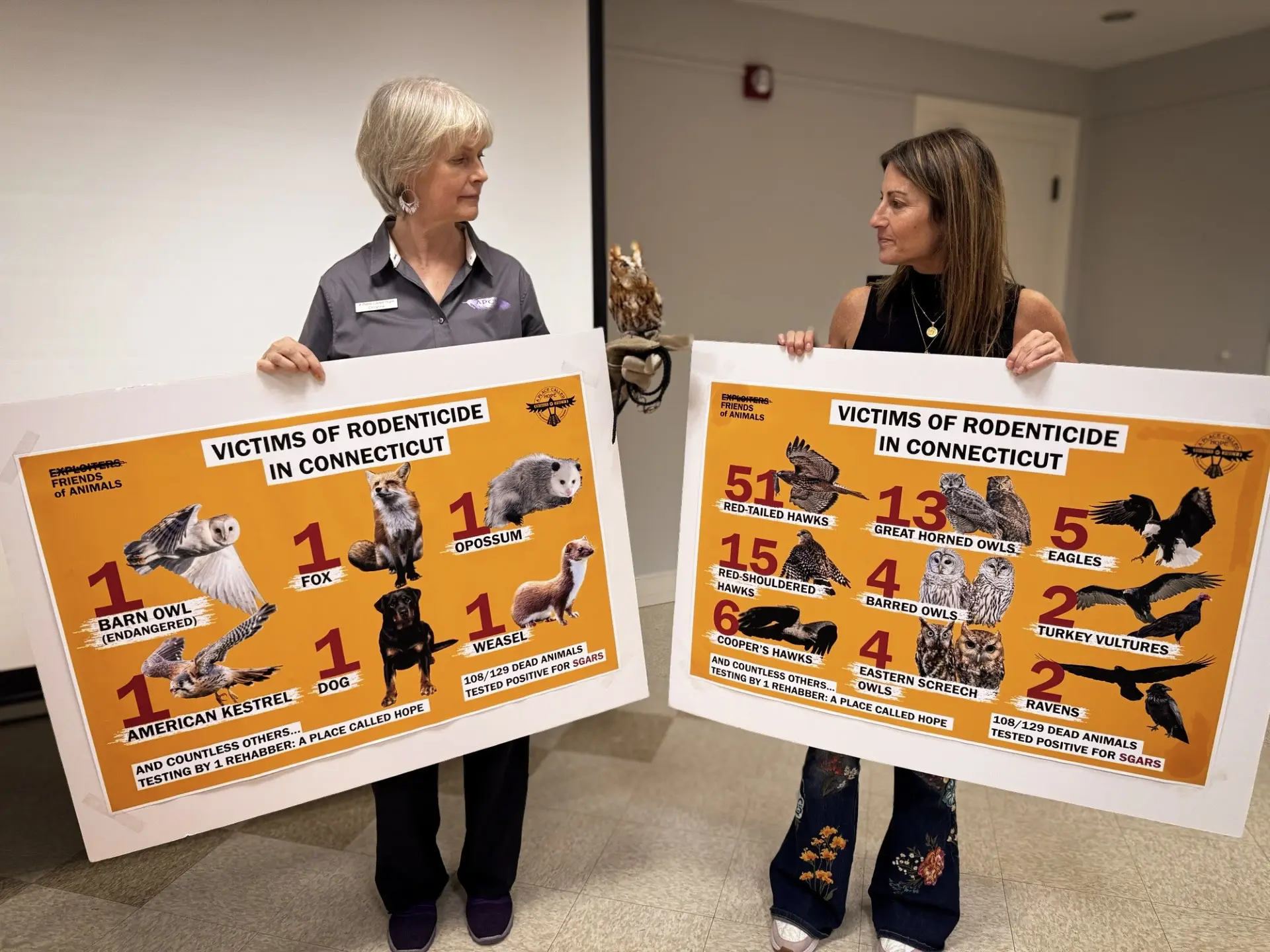
Friends of Animals and A Place Called Hope, and special guest Koso the Eastern screech owl, a miraculous survivor of rodenticide poisoning, presented our last Think Outside the Bait Box discussion of 2026 to the Old Saybrook Conservation Commission and residents on Nov. 5 at the Acton Library in Old Saybrook.
We discussed how Connecticut’s beloved raptors and mammals are under siege from these powerful, long-lasting poisons making their way up the food chain. Anticoagulants work by preventing blood from clotting. So, animals are dying a slow agonizing death from internal bleeding after consuming poisoned rodents who’ve taken the bait from those ubiquitous black boxes you see outside grocery stores, around housing developments and town parks. It is the definition of animal cruelty.
We also discussed safe alternatives to preventing rodent infestations, and A Place Called Hope’s latest test results. Of the 26 tests on dead birds done since January, 24 were positive for SGARs, underscoring that a bill that was signed into law in 2025 and went into effect Jan. 1, 2026 protects the pest management industry, not wildlife.
The weak language only made SGARs restricted use, which means licensed applicators can still use them. The law does not change how and when the 267 individuals who hold commercial supervisor certification in the rodent category in CT can use SGARS, nor is there any requirement for the licensed applicator to prove an infestation exists.
Overall, A Place Called Hope has tested 129 dead animals since 2021, and 108 have tested positive for SGARs—an 84% positivity rate. Of course, there are countless other deaths that have not been recorded because none of the other 149 active wildlife rehabbers in Connecticut are paying for the testing because it is so expensive.
We are calling out the municipalities that have had the most victims, according to the testing: Hartford, New Haven, Cheshire, West Hartford, Madison, Middletown, Guilford, Southington, New Britain, and North Haven.
New bills are officially introduced, assigned numbers, and published as the legislative session opens and gets underway Jan. 6. Stay tuned for updates on our 2027 legislative efforts!
Nicole Rivard is the Editor-in-Chief/Media/Government Relations Manager for Friends of Animals