

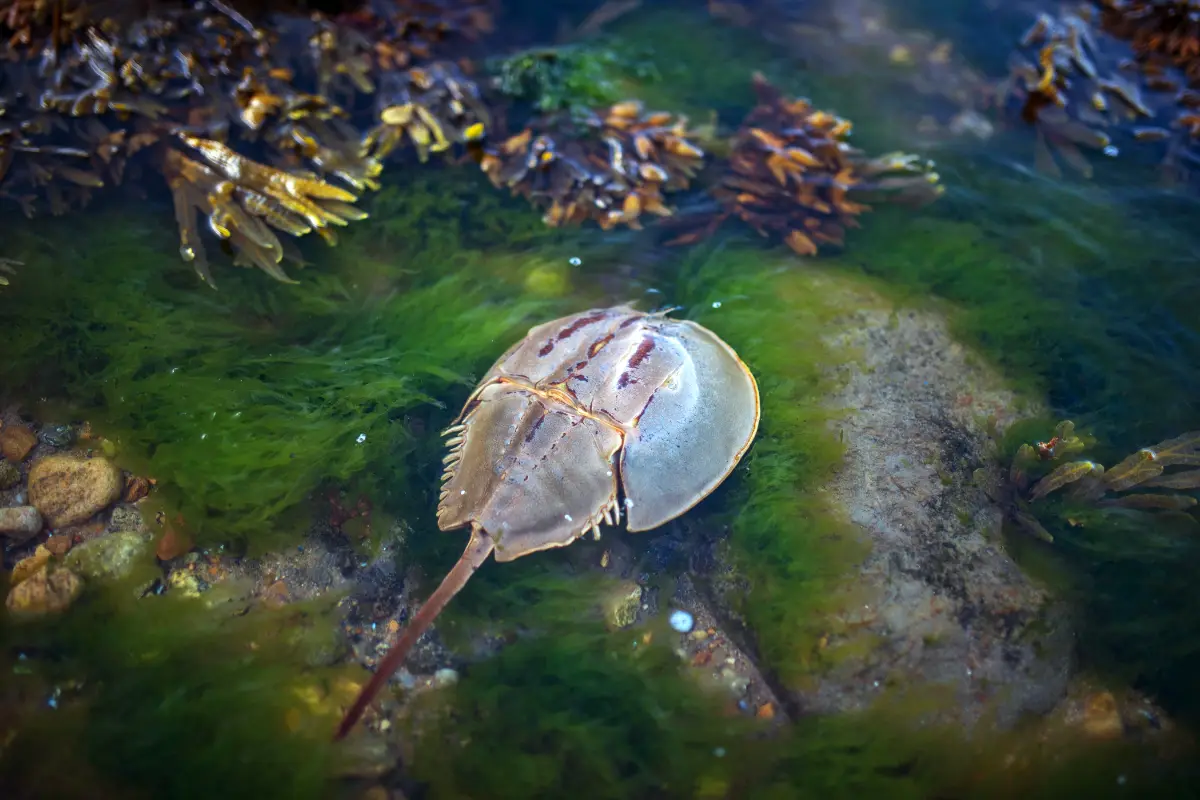
Friends of Animals has sued the National Marine Fisheries Service for failing to make a preliminary decision on whether to protect Atlantic horseshoe crabs under the Endangered Species Act. FoA petitioned the agency in 2023 to protect horseshoe crabs because of widespread exploitation and killing by the commercial bait and biomedical industries, threats to its habitat from climate-change-associated sea-level rise, and other human factors such as shoreline development.
“Human exploitation is pushing this ancient species toward extinction, and continued delay by the National Marine Fisheries Service only increases the risk,” said Jennifer Best, director of FoA’s Wildlife Law Program. “Friends of Animals will not stand by while the agency fails to act on our Endangered Species Act petition and leaves horseshoe crabs in harm’s way.”
The Atlantic horseshoe crab, a marine arthropod found along the Atlantic coasts of North and Central America, has existed for approximately 445 million years, well before the dinosaurs roamed the earth. The killing of horseshoe crabs ramped up in the ‘90s when fishers started capturing them and chopping them up for bait for eel and whelk. They focused on mature, egg-bearing females due to their larger size and because the eggs could be used as additional bait.
If horseshoe crabs are listed as endangered under the ESA, they could not be killed without a permit.
FoA’s petition documented that the International Union for the Conservation of Nature (IUCN) has designated the Atlantic horseshoe crab as “vulnerable” to extinction and estimated future reductions of greater than 30% in a significant portion of the species range. These include decreases of 100% in Gulf of Maine, 92% in New England, 55% in Florida, and 32% in Northeast Gulf of Mexico. According to the IUCN’s report, assignment of the greater risk category of “endangered” is warranted at regional and sub-regional levels.
FoA’s petition also presented scientific information showing that abundance of horseshoe crab eggs, which are essential for survival of the threatened rufa red knot shorebird, remains approximately 15 times lower than it was before the unregulated killing of horseshoe crabs in the 1990s. In 1998, partially in response to concerns that declining horseshoe crab numbers would negatively impact the red knot, the Atlantic State Marine Fisheries Commission adopted a Horseshoe Crab Fisheries Management Plan (FMP).
Although the FMP resulted in decreased numbers of crabs killed as bait, more than 700,000 horseshoe crabs were killed for that purpose in 2021.
The truth is the FMP fails to adequately protect the Atlantic horseshoe crab because it is not intended to do so; rather FMP is clear that the ASMFC considers the horseshoe crab a “resource” that must be preserved only to the extent that it remains available “for continued use by” the public, listed species, and industry.
“The FMP focuses more on horseshoe crabs killed than horseshoe crabs left in the ocean. This flawed approach to crab conservation cannot ensure its survival,” Best said. “When the Atlantic horseshoe crab’s interests don’t align with those of industry or with the red knot, the horseshoe crab is sure to lose.”