

Late last night, the Bipartisan American Affordability Jobs Act (BAAJA) passed through the Senate 62-33, and is now onto the House.
Friends of Animals wrote members of congress, urging them to oppose this ridiculous, odious bill. We also wrote our members asking them to contact their representatives and tell them to VOTE NO on BAAJA.
BAAJA still has to clear the House, meaning the fight is not yet over, there’s still time to contact your representative and make your position known.
Call (202) 224-3121 or find your representative here.
Despite its innocuous name, BAAJA would fundamentally undermine two of our nation’s most important environmental laws—the National Environmental Policy Act (NEPA) and the Endangered Species Act—and severely weaken the federal government’s ability to protect our nation’s natural resources, wildlife, and public lands.
BAAJA is being supported by industry groups such as the Data Center Coalition, the American Petroleum Institute, and the National Mining Association, who could all stand to gain from the plundering of this nation’s natural resources.
A big part of the bill centers around data centers. BAAJA would facilitate the construction of these energy-intensive facilities and the infrastructure needed to power them, including fossil fuel power plants and pipelines.
BAAJA would even weaken environmental reviewal processes, making it easier for corporations to build energy infrastructure that directly harms animals.
The mid-term elections show that Americans don’t want to continue policies like this that are a giveaway to big business and data centers. BAAJA, however, could make it easier to build gas-powered data centers on public lands, which would be so incredibly destructive.
Even the praise for BAAJA’s “affordability” is contradictory. Proponents commend the bill’s text promising accelerated permitting and development of energy infrastructure, including fossil fuel energy infrastructure.
But weakening environmental safeguards and increasing greenhouse gas emissions is costly.
Environmental degradation is a cost that appears as a loss of biodiversity, an uptick in extreme weather, strained water resources, the destruction of natural infrastructure that harbors wildlife, and even public health consequences—we all pay the price of a dirtier environment.
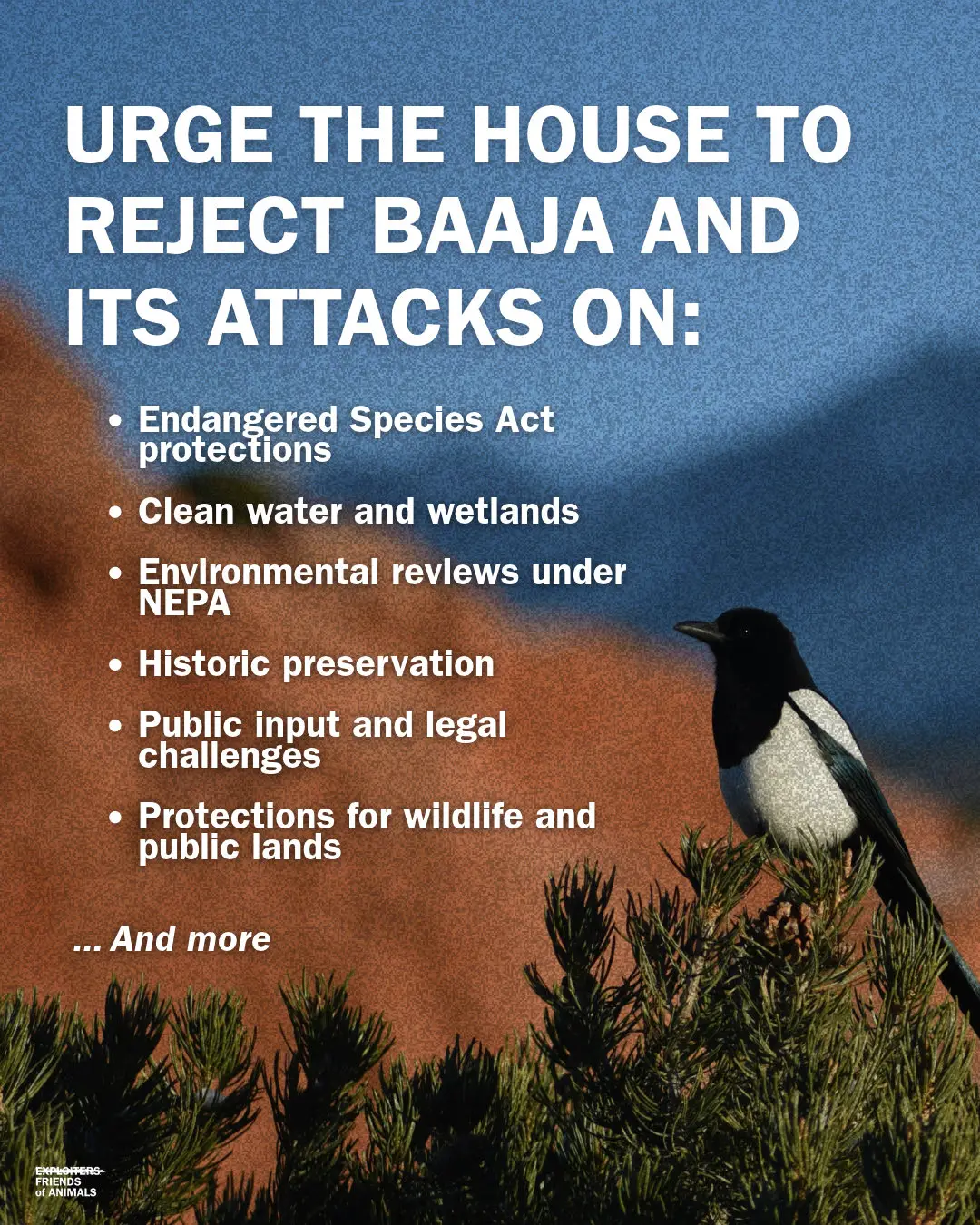
BAAJA would fundamentally attack:
- The Endangered Species Act
- Clean water and wetlands
- Environmental reviews under NEPA
- Public input and legal challenges
- Protections for wildlife and public lands
You can read more about FoA’s opposition to BAAJA here. Follow our accounts on X, Instagram, Facebook, and Threads to watch along for further updates.
In the meantime, though, there’s still time to make your position known. Call (202) 224-3121 or find your representative here.