

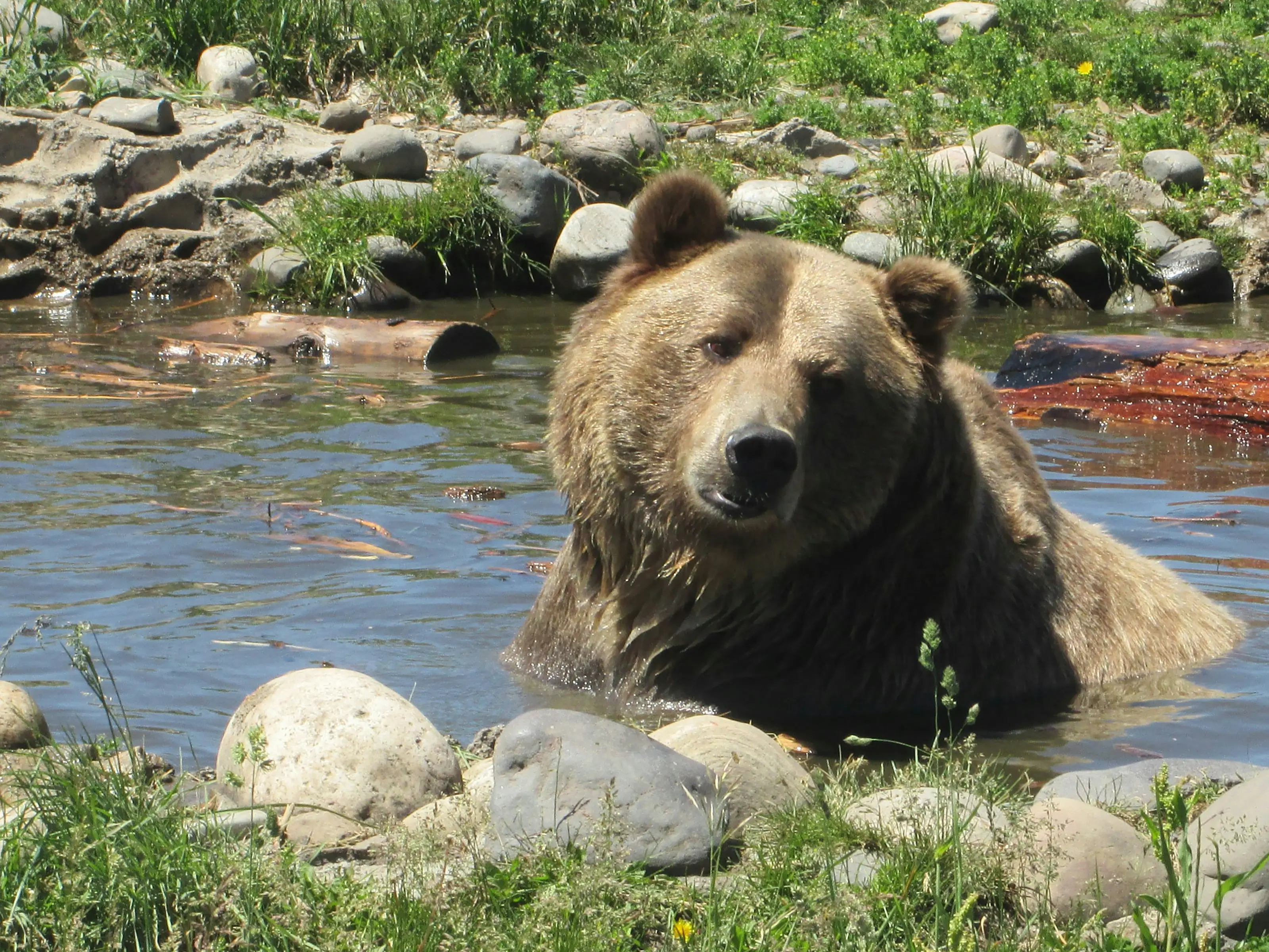
Rule makers are once again meddling with Montana’s iconic grizzly bears.
As apex predators, grizzly bears have an indispensable place in Montana’s ecosystem. Montana’s alpine meadows, dense forests and river valleys provide ideal habitat, making the state one of the remaining sanctuaries for these incredible creatures. Due to hunting, grizzly bears found themselves on the brink of extinction by the early 20th century. Yet because of concerted conservation efforts, Montana’s grizzly population has since rebounded, and there are about 2,000 in the state today.
Still, though, lawmakers are still wrestling with how to “manage” the legendary bears to mitigate conflicts, including potentially killing them.
“Grizzly bear recovery depends on protecting individual bears, their ability to reproduce, and connections between populations,” said Liz Holland, Philanthropy and Communications Manager for FoA’s Wildlife Law Program. “Wildlife Services should fully evaluate a nonlethal approach and make better use of existing resources to support coexistence. Montana should prioritize keeping bears alive, not simply managing their deaths.”
That’s why Friends of Animals submitted comments in response to the Grizzly Bear Damage and Conflict Management in Montana Draft Environmental Impact Statement (DEIS), prepared by the USDA, Animal and Plant Health Inspection Services (APHIS), and Wildlife Services Montana (WS-MT).
The DEIS aims to set out a coordinated plan for reducing grizzly bear damage and interactions, while still protecting their long-term viability. Under the DEIS, everything is on the table, including lethal management—killing grizzly bears. The DEIS does lay out some nonlethal management strategies, such as bear-resistant garbage and grain containers, range riders, fencing, and carcass removal programs.
FoA knows these are effective in reducing grizzly bear interactions. In fact, Montana Fish, Wildlife, & Parks even recognizes that securing attractants is the single most effective way to prevent grizzly bears from becoming habituated or food-conditioned and to reduce bear killings and human-caused bear conflicts. In our comments, FoA noted that the Final Environmental Impact Statement (FEIS) ought to examine whether the evidence supporting any amount of killing demonstrates reductions in conflict recurrence; since it’s so clear that the nonlethal strategies are supported by evidence.
These magnificent bears are an essential component in Montana’s ecosystems, and not to mention Montana’s heritage, they’re the official state animal; their continued recovery deserves a management approach that doesn’t involve killing. Grizzly bears are listed threatened under the Endangered Species Act.
Despite this, the DEIS claims that removing “lethal management” from consideration after nonlethal measures failed to completely resolve the perceived problem is not “reasonable, logical, or professional.”
This is totally arbitrary. This conclusion scoffs at the weight of evidence showing that nonlethal risk-reduction measures are more effective at preventing conflict, and that killing grizzly bears is unlikely to resolve much. Killing individual grizzly bears will not prevent future conflicts because it doesn’t address the conditions that attracted the bear in the first place.
If the entire point of the DEIS is to reduce future interactions, then the nonlethal strategies are the best bet.
The purpose of the DEIS shouldn’t be to preserve lethal management. It should be to preserve grizzly bears by reducing and preventing conflicts; a nonlethal approach best serves that purpose.
Furthermore, the DEIS fails to fully examine the greater consequences of killing grizzly bears, particularly when it comes to mothers with dependent cubs.
A five-year study, appearing in the journal Frontiers in Conservation Science, conducted between 2019-2023, found that 10 out of 12 orphaned grizzly cubs released following rehabilitative care did not survive, with nine of these deaths occurring between the time of release and the first denning period.
These findings underscore the fact that killing individual bears have far harsher consequences beyond that immediate death, especially for dependent offspring and long-term population recovery.
FoA urged WS-MT to analyze a fully non-lethal alternative, and that analysis should evaluate things like staffing, funding, and follow-up assistance necessary to prevent and resolve perceived conflicts through nonlethal methods. Montana’s grizzlies and its greater ecosystem would benefit.
Photo via Kent Goodman, Unsplashed