

By Nicole Rivard
We hit the ground running this year, appearing in court in January defending Utah’s prairie dogs. We are challenging permits and a range-wide plan by the U.S. Fish and Wildlife Service (FWS) that allows the removal and killing of thousands of threatened Utah prairie dogs, imperiling the species just to appease a relentless local drive for development.
“We’re not about to give the U.S. Fish and Wildlife Service a green light to drive these animals to extinction,” Friends of Animals President Priscilla Feral said. “Most moves federal wildlife managers in this Administration make derail protections for threatened wildlife such as prairie dogs. They neglect to see the moral and scientific value of seeing these social, intelligent animals as a benefit to western grassland ecosystems, or worthy of our affection and protection.”
This case rings all our bells because of its similarity to the behavior of homeowners who fail to see animals like groundhogs and deer as worthy of protection and treat them as pests especially in the summertime when they are being baited by people’s gardens.
Prairie dogs were declared an endangered species in 1973 after their population dropped to a few thousand. In 1984, FWS downgraded the species’ ESA status to threatened after the Utah Division of Wildlife Resources unsuccessfully petitioned FWS to delist Utah prairie dogs altogether. FoA’s lawsuit alleges that FWS’s plan violates the ESA and the National Environmental Policy Act.
More than 7,000 prairie dogs could be removed or killed over a 10-year period under the new plan, plus an additional 15,000 independent of development, totaling more than a quarter of the entire population. Up to 1,750 acres of their habitat could be destroyed as well.
Prairie dogs are keystone species. They serve as prey for terrestrial predators such as American badgers, black-footed ferrets, bobcats, coyotes and long-tailed weasels, and for avian predators such as ferruginous hawks, golden eagles, northern goshawks, prairie falcons and Swainson’s hawks. Their burrows provide homes for a diverse array of animals, such as black-footed ferrets, burrowing owls, bull snakes, tiger salamanders and hundreds of species of insects and spiders.
Recent studies have also shown that prairie dogs help prevent erosion, decrease soil compaction, and encourage the growth of grasses and plants that large grazers such as bison and pronghorn tend to prefer.
IN OUR OWN BACKYARD
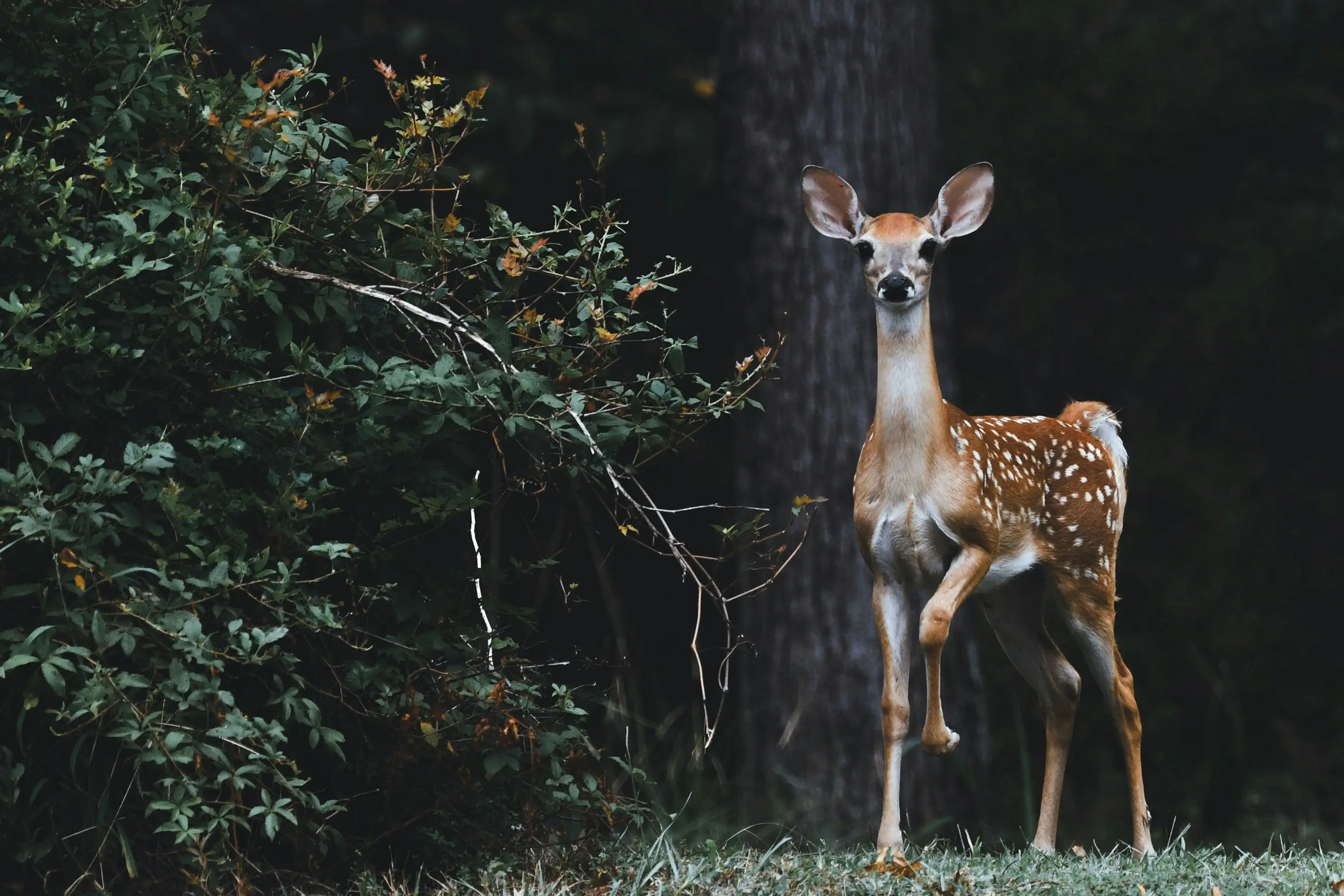
We were miffed—yet not surprised—last fall to see an ad circulating online promoting the start of deer bow hunting season in Darien, Connecticut, where Friends of Animals is headquartered. The ad not only told the marauders how to obtain licenses and find registered hunting properties, it called for property hunters to register their own land, granting bow hunters access.
The message is clear: if you take offense to helpless deer trying to survive in ever shrinking habitats, you can just as easily call in a deer killer who will ambush and pump an unsuspecting deer full of arrows.
It’s important to call these endeavors out for what they are: repulsive killing under the guise of “management” and a failure to offer a humane alternative, coexistence. To counter this, we were able to push the town to publish our article in its weekly newsletter detailing nonlethal, proven ways to protect yards year-round from deer.
Deer are often misunderstood and maligned for liking the same things humans do—flowers, ornamental bushes and gardens! Right now, during the summer growing season, they might visit your hostas, hydrangea and veggie gardens. In colder weather they’re drawn to broadleaved and needle-leaved evergreens such as rhododendrons and azaleas.
If fencing is not an option, a good repellent spray regimen will work wonders. During fall and winter, you’ll only be spraying every four- to-eight weeks. Spraying every 10 to 14 days is recommended in the summer.
Anything more than five or six feet above the ground will be out of their reach and will not need to be sprayed.
Ninety-eight percent of Darien is developed, so it is incumbent upon residents to be good neighbors to the wildlife. Communities across the country should recognize that sharing space with wildlife doesn’t warrant a crisis.
TIPS TO DETER GROUNDHOGS
Likewise, there are ways to deter groundhogs—who, by the way, are closely related to prairie dogs—from eating your flowers, vegetables, and plant seedlings. They have an important place in the ecosystem too, as food for coyotes, foxes, hawks and eagles and their burrows provide a respite for amphibians and reptiles.
They are also great moms. Newborn groundhog pups are altricial, meaning they are born blind, hairless, and completely dependent on their mother. Also known as kits, they are born in the spring and nurse for 44 days until they are strong enough to start eating solid food.
So, if you’re thinking about “evicting” a groundhog from your yard and relocating it, the most humane time is from mid- to- late summer to avoid separating a mother from her babies.
However, the best long-term solution is to protect gardens with fencing. Install a sturdy fence made of welded wire with mesh size no bigger than 3 by 3 inches and that reaches a height of 3 to 4 feet above ground level. The most robust technique for preventing digging is the installation of an “L-footer,” which creates a horizontal underground barrier. Groundhogs are excellent diggers, so make sure the barrier extends at least a foot underground and bends outward at the bottom.
Deterrents such as Epsom salt, red pepper flakes, talcum powder, and garlic can also be place around the garden perimeter or strategically placed near burrows. First place the repellent in the burrows nearest the property. Then one or two days later, place another repellent in burrows farther away, repeating the process as necessary until the groundhogs are gone.
But the truth is, if you have a groundhog burrow on your property, or any species trying to eke out a space to survive and there aren’t any conflicts, just live and let live.