

Around this time last year, I was in a nature preserve near Friends of Animals’ headquarters in Darien, Conn., with my English bulldog Lila. We were sauntering along a trail when I heard a strange noise.
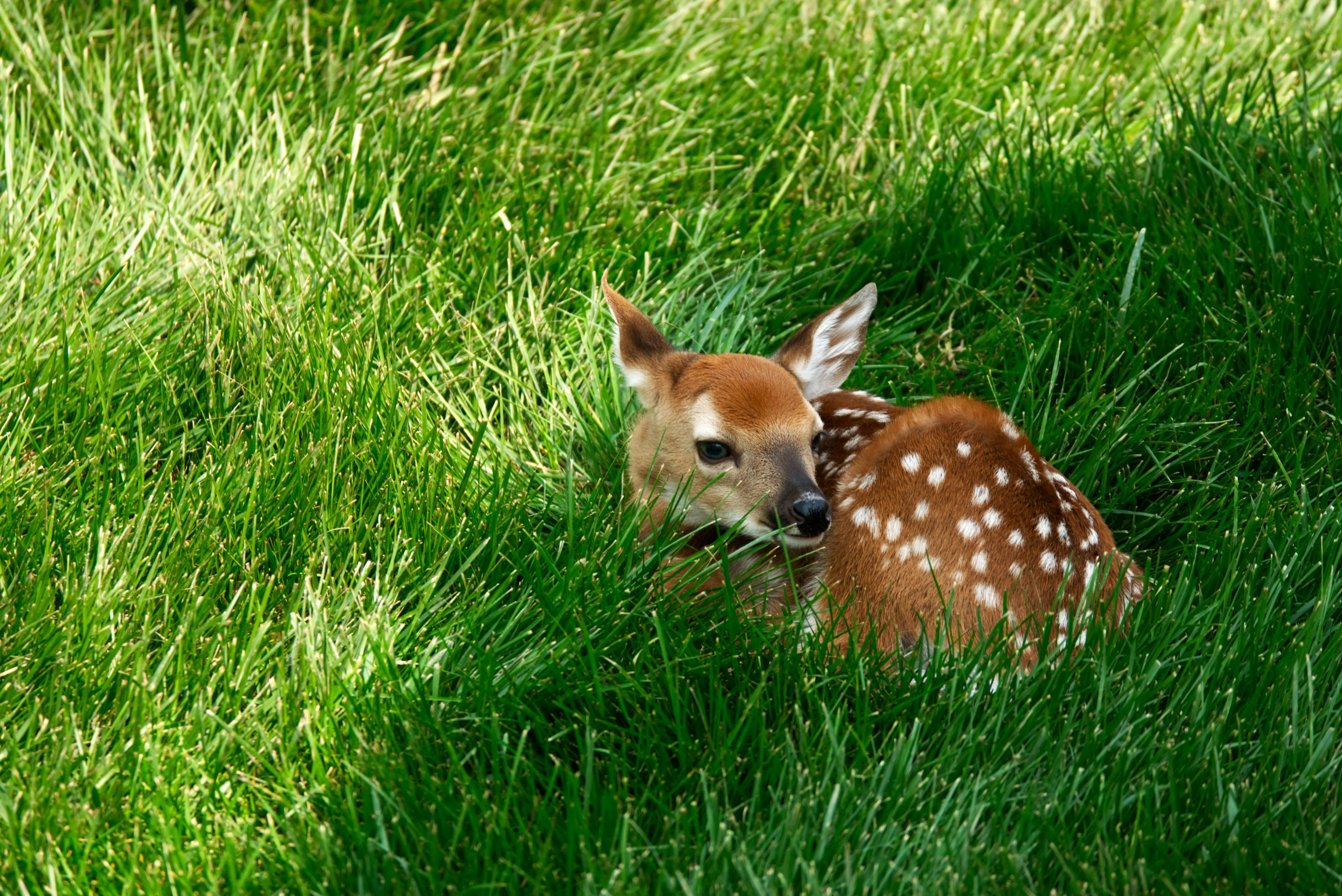
I climbed up the bank on the side of the trail to peek and see where the sound was coming from. I was surprised to see the most precious baby fawn standing up and vocalizing, curious about and exploring her wooded surroundings.
She approached my dog and I, and after letting her check us out a little, we backed away and kept walking down the trail.
I was concerned that she was so little and all alone, until a little further up the path I saw another fawn bedded down. And minutes later, I was relieved to see an adult prancing by, probably on her way to return to her offspring.
Unfortunately, when some people stumble across a bedded deer fawn or other young wildlife, they think they’ve been abandoned and grab them to get them help, not knowing human interference is problematic.
This spring the Connecticut Department of Energy and Environmental Protection (DEEP) put out its annual press release educating the public on this topic much earlier than normal based on a rash of unbelievably bad situations involving people who probably wanted to be helpful but put the young wild animals at great risk.
“We keep telling folks to reach out to us or wildlife rehabilitators for guidance before taking action,” explained Jenni Dickson, director of DEEP’s Wildlife Division. “It is really hard for people to understand that wild female animals will leave their young in a ‘safe’ place and leave for extended periods to find food.”
For instance, deer typically give birth between May and late June. Immediately after a fawn is born, the doe consumes the afterbirth and licks the fawn all over to eliminate scents that may attract predators. Within 10 hours of birth, the doe will move the fawn to a different area, and the fawn will instinctively bed down. If the doe has multiple fawns, she will separate them to reduce the risk of both fawns (sometimes three) being taken by a predator.
During the first few weeks of life, mothers leave their fawns alone for much of the day. To meet high lactation demands, the doe spends much of this time in search of high-protein forages. This absence also helps prevent the doe’s scent from leading predators to the bedded fawn.
CT DEEP recommends that if you find a fawn, leave it alone for at least 48 hours to allow the mother to return. Keep people and pets away.
DEEP also offers the following guidance for common springtime wildlife encounters:
Bear Cubs: People often are unaware that female bears will leave their cubs alone or send them up trees while they search for food. These cubs are not abandoned, and while they may vocalize before the sow returns, this is not necessarily cause for concern. For their safety, leave cubs alone and contact the DEEP Wildlife Division for further guidance, or if you live in another state, contact your state wildlife agency. Removing cubs from the wild can unintentionally orphan them if the adult bear cannot locate and reunite with the cubs. Sows may travel a mile or more while foraging and can leave cubs unattended for several hours, sometimes up to 12 hours or more. This behavior also can occur during inclement weather; cubs are protected from the elements by their fur and are able to withstand drops in temperature.
Fox Kits: It is common to see fox kits playing near dens in spring and early summer. This is normal behavior and not a cause for concern. Foxes only use dens temporarily, and daytime activity is typical. Do not feed or approach fox kits. Both parents help raise the young, so orphaning is rare. Sick or injured foxes should be reported to local Animal Control, local police, or if you live in CT, DEEP Environmental Conservation Police (860-424-3333).
Rabbits: Young rabbits are especially vulnerable to pets and lawn equipment. If you find a nest, avoid disturbing it and keep pets away. Within 2–3 weeks, the young will leave on their own. Mother rabbits visit the nest only briefly at dawn and dusk. If a nest is disturbed but the young are unharmed, return them and cover the nest. If a rabbit has been in contact with a pet or appears injured, contact a wildlife rehabilitator.
Squirrels. Where did you find the baby? If tree work was done recently, or there has been high winds or a storm, give the mother a chance to reclaim her babies as long as they are uninjured, warm and dry. Leave the baby at the tree base during daylight hours and monitor them from a distance. The babies should be left out for the mother exactly where they were found or as close as possible to it. Don’t cover them with a blanket (mother won’t see them), and don’t put them in a deep box (mother won’t be able to access them). If a container is necessary, use a shallow shoe box (with flannel or fleece on the bottom). If it is chilly outside, or if the babies are not fully furred and their eyes are not open, they will need a heat source, such as a hot water bottle or a chemical hand warmer covered in a thick sock. Also do not feed the baby. If they make crying sounds, use your cell phone to record them, then play the cries back on high volume. This is the best way to draw the mother in. She will respond to her babies’ cries.
If a baby squirrel is active and almost adult-sized, and is following people and even trying to climb them, this behavior indicates a hungry juvenile who has lost his/her mother.
At this stage, they will run up to anything that moves. This animal needs to be taken to a wildlife rehabilitator for assistance.
Birds: Many young birds found on the ground in early summer are fledglings learning to fly and still are being cared for by their parents. If the bird is fully feathered, leave it where it is and keep pets away.
If a bird has no feathers (a nestling), try to return it to its nest. Wearing latex or nitrile gloves can help prevent your scent from clinging to the nestling and attracting predators. If the nest is gone, a simple replacement nest (such as a small basket with grass) can be secured in a nearby tree or shrub. Observe for at least an hour to ensure the parents return.
If an animal is clearly injured or orphaned:
Avoid direct contact
Keep pets and children away
Contact a licensed wildlife rehabilitator. If you live in CT, you can contact DEEP Wildlife Division who can provide further guidance. There are approximately 300 authorized volunteer wildlife rehabilitators in CT with the skills and training to care for sick, injured, and orphaned wildlife. To obtain the names of CT wildlife rehabilitators in your area, check the DEEP Dealing with Distressed Wildlife webpage, or contact the DEEP Wildlife Division at deep.wildlife@ct.gov or 860-424-3011.
Wild animals are not pets. Keeping wild birds or mammals as pets is illegal and harmful. Proper care requires specialized knowledge, considerable time, and state permits. Animals raised by humans often cannot be returned to the wild.
“Although it may be natural to want to help young animals, intervening can do more harm than good,” Dickson said.
Nicole Rivard is media/government relations manager for Friends of Animals.