

In 2024 I got to go to Africa and experience the most untouched, wild, forested place I’d ever seen, home of the Chimpanzee Rehabilitation Project, which Friends of Animals has supported for decades.
Yesterday, I was reminded we can experience awe and wonder with the wildlife we encounter everyday—songbirds, squirrels, hawks, frogs—if we are present enough to look for and appreciate them.
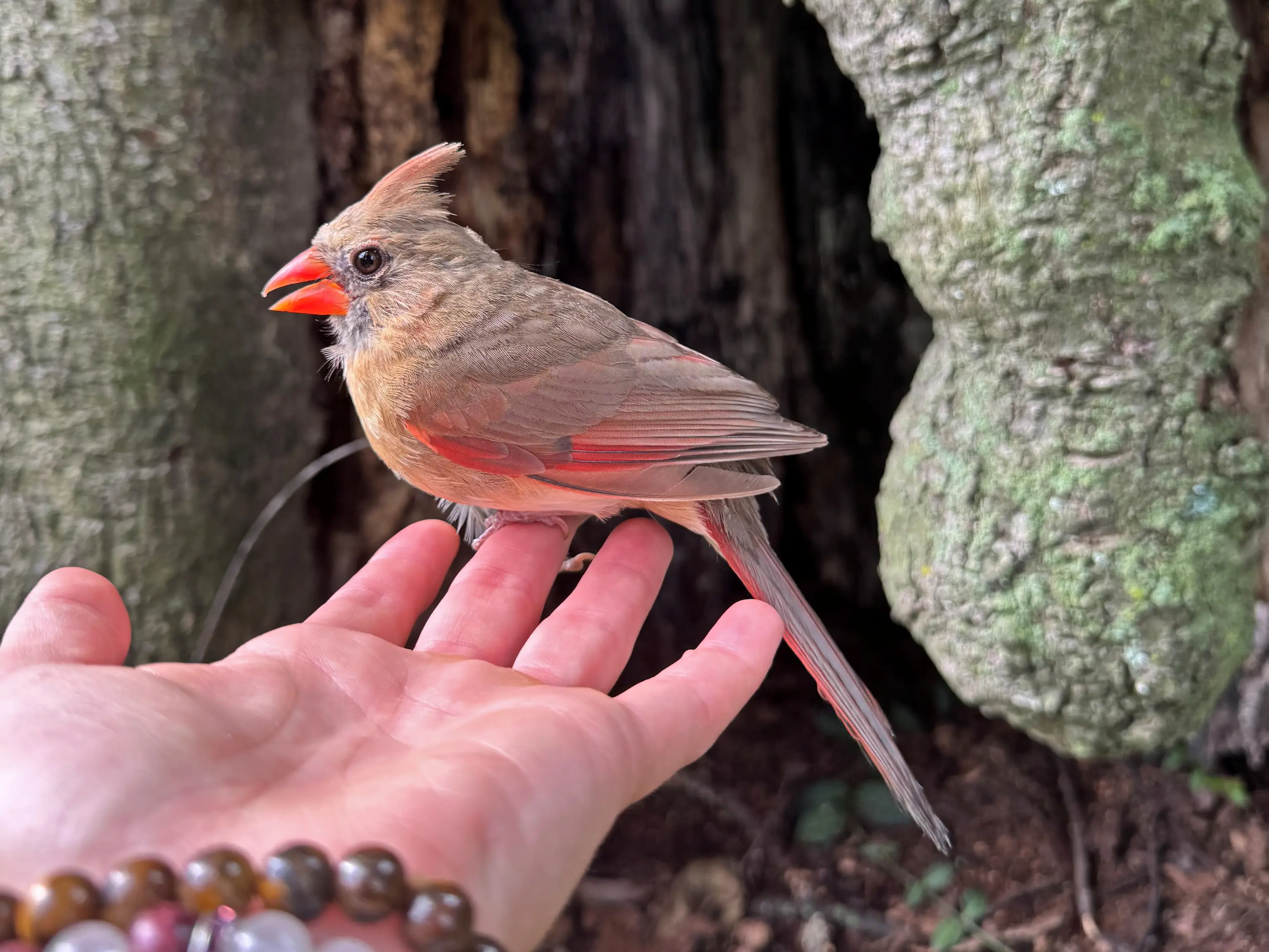
I was driving to work and saw a female cardinal in the road, cars whizzing by. I parked on a side street, scooped up the stunned little bird, and carried her to a safe spot—a hollow that had formed at the base of an enormous tree set way back from the road.
I thought maybe she was a fledgling learning how to fly in that two to four-week ground phase. Cardinal fledglings face severe risks because they leave the nest before they can fly well, spending several days hopping helplessly on the ground. Their main dangers include outdoor domestic and feral cats, birds of prey like hawks, climbing snakes, and larger mammals such as raccoons and foxes.
When I texted a photo of her to some wildlife rehabber friends, they explained that she was more mature than a fledgling. They pointed out it looked like there may be some feathers missing on the back of her head, so they suspected she may have been clipped by a car or bounced off a windshield.
Collisions with vehicles are believed to be among the top five direct causes of bird mortality in the United States, according to U.S. Fish and Wildlife service. A study estimated that between 89 million and 340 million birds die annually in vehicle collisions on U.S. roads.
Lucky for this cardinal, there was no blood or visible injuries. Her grip on my fingers was tight, which they said was also a good sign. When I went back and checked on her at lunchtime and she was nowhere to be found—I hoped she was getting back to being a cardinal.
She left an impression on me, and I couldn’t stop thinking about her all say. The experience was a reminder that all wildlife are just here trying to eke out a life in an ever-shrinking natural world. And they don’t just have to survive predators, they face a myriad of human-caused threats: roadways, unbridled development, pesticides, rodenticides, pollution, etc.
That’s why humans should be lending a hand to help protect these creatures whenever we can. It’s annoying to us at Friends of Animals that people on the social networking platform Nextdoor often sound the alarm bells if there’s a fox, coyote or bear sighting. They aren’t here to do us, children, or pets harm, so it’s unfair to treat them like villains.
Don’t even get me started on how last month the local and national media released an edited video of an incident in Torrington, CT, making it look like someone’s dog saved a boy from a black bear. But the video in its entirety revealed a different narrative–the bear sauntering in a different direction and then the dog chasing him towards the kid!
Another teaching moment missed. Keep your dogs leashed if you live where bears live, and remove food attractants from your yard.
There are so many little things people can do in the way of changing their behaviors that could provide a safe space for wildlife. I have found that following the social media accounts of our local wildlife rehabilitators provides a crash course in how to be kind to and protect wildlife everyday.
For instance, the largest wildlife rehabber in CT, Wildlife in Crisis, posted this about bunnies this week. “This is our fourth wave of baby bunnies this summer and it’s been a doozy. We just released 48 grown up buns from the last wave. The most recent five babies were brought to us after two of their siblings were mortally wounded by a weed whacker. Since their nesting material and surrounding shrubbery had been removed, it was determined that removal was the best course of action. Sorry momma, we’ll take it from here! All have settled in and are nibbling on hay fragments, clover and thankfully drinking formula from a little ceramic bowl.”
The lesson here: before getting the lawnmower out, give your yard a good once-over to make sure it’s free of rabbit nests to avoid any unnecessary trauma — for you and the baby rabbits.
Rabbit nests often look just like a small patch of dead grass on your lawn. That’s because the mother rabbit makes her nest by digging a small hole in the ground and then covering it with grass, leaves and other plant material to help protect the babies. The babies are right under that protective layer of grass and plant matter, making them particularly vulnerable to the blades of our lawn mowers.
And remember the hollow at the bottom of the tree where I placed the cardinal. Leave them please!
Wildlife in Crisis writes: This week we received a baby squirrel and woodpecker. Both lone survivors after their hollow trees were cut down. Birds are still nesting and squirrels are beginning to have their fall litters. Hollow trees serve as vital hosts for a large variety of wildlife and the food they rely upon to feed themselves and their young. Nature is messy. Sterile yards are deadscapes. With the majority of our state being overtaken with urban and suburban sprawl every acre counts. How you manage your yard can mean life or death for resident wildlife. Please choose sanctuary over ruin.
Perhaps people would embrace the natural world instead of fearing or ignoring it altogether if they engaged in less screen time. According to data from DataReportal, the average American spends 6 hours and 40 minutes looking at a screen every day—that includes computers and mobile phones.
People’s overall connection to nature has declined by more than 60% since 1800, almost exactly mirroring the disappearance of nature words such as river, moss and blossom from books, according to a study by Miles Richardson, a professor of nature connectedness at the University of Derby.
We’ve got to do better. Our lives and the lives of the animals who we share the planet with depend on it.
Start today—replace some screen time with some green time. You won’t regret it. I never do!
Nicole Rivard is media/government relations manager at Friends of Animals and Editor of Action Line.