

OpEd as seen in The Denver Post
Colorado does not have a wild horse problem as a recent Denver Post headline states. The real issue lies with the meat industry’s grip on our public lands. The federal government authorizes ranchers to graze an exorbitant amount of cattle in wild horse herd management areas. It is this industrial use of our public land that degrades it.
Instead of confronting the outsized influence of private industry on public lands, the state of Colorado looks the other way and scapegoats wild horses.
Evidence of this problem abounds in the data publicly available from the Bureau of Land Management’s (BLM) allotment reports. There are four grazing allotments in the Piceance-East Douglas herd management area, where a staggering 10,960 cattle are allowed to graze at various times throughout the year. Yet the Bureau of Land Management insists the area can sustain just 235 wild horses based on BLM’s outdated “appropriate management levels” or population targets. Only 362 wild horses are allowed to graze in Sand Wash Basin, yet a staggering 12,026 sheep and 300 cattle are allowed to graze in three allotments there.
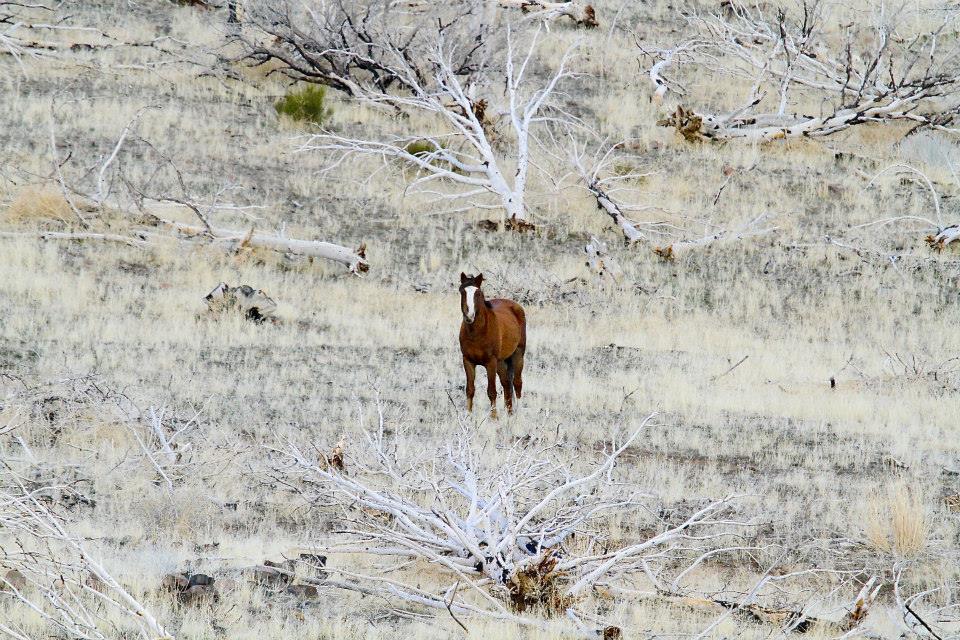
According to BLM’s 2025 program data, there are a measly 1,516 wild horses left in Colorado on 365,988 acres of land. The fact that the state is now paying the federal government to deploy paid professional darters to expand its birth control darting program in lieu of violent helicopter roundups may make it look like Gov. Jared Polis is listening to public concerns. But the truth is, Colorado’s wild horses are being managed to extinction. A model for the West? It should be anything but.
Research shows PZP sterilizes wild horses after multiple uses and results in risky out-of-season foal birth and behavioral changes that can affect the overall health of the herd. The widespread use of PZP is contrary to the true core intent of the Wild Free-Roaming Horses and Burros Act of 1971, which was to restore wild horses as harmonious components of the public land ecosystem.
Colorado should not be throwing taxpayer money on fertility control merely to perpetuate the broken system that sacrifices the protections Congress afforded wild horses to the meat industry and other commercial interests. We have tried to get a meeting with Gov. Polis to question why he accepts BLM’s efforts to reach arbitrary population targets that it calls “Appropriate Management Levels,” or AMLs.
As the National Academy of Sciences reported in 2013, “How AMLs are established, monitored and adjusted is not transparent to stakeholders, supported by scientific information, or amenable to adaptation with new information and environmental and social change.” The BLM, which commissioned this report, has never sought to correct these problems.
It is a national disgrace that there are now more wild horses in captivity — 59,622 — than roaming free. There are only 53,797 wild horses left on federal public lands.
It is high time to halt the roundups and the birth control and to stop blaming wild horses for the severe damage the meat and other industries inflict on federal public lands. Of the 245 million acres of public land managed by the BLM alone, 155 million is open to livestock grazing. By contrast, BLM restricts wild horses to less than 27 million acres. In all, roughly 2 million cattle graze public lands, not to mention sheep, and the government has authorized thousands of oil, gas and mineral extraction projects.
Recent studies show that wild equids are key to healthy ecosystems. The Equid Specialist Group of the International Union for Conservation of Nature’s Species Survival Commission recommends minimum populations of 2,500 individuals for the conservation of genetic diversity. Currently, no single herd management area has a minimal viable population.
In The Denver Post article, a darter comments that “the wild horses don’t like them very much.” Well, who could blame them? They are literally fighting for their survival.
Jennifer Best is the director of Friends of Animals Wildlife Law Program based in Greenwood Village.