

In June, the NYC carriage trade claimed two lives in a week. City Council can stop it from happening again.
On July 15, the New York City Council Health Committee will hold the official public hearing on Intro 943, legislation reintroduced last month by Council Member Christopher Marte, which would phase out the city’s longstanding and controversial horse carriage industry altogether by June 1, 2028, stopping new licenses from being issued immediately.
The carriage industry is now trying to get a leg up. Pun intended.
So, it has pivoted from talking about increasing safety measures like hitching posts to spreading the narrative that all the horses are going to end up in the slaughter pipeline if Intro 943 gets signed into law. It’s a desperate move to deflect from the danger and cruelty inherent in the brutal horse-drawn carriage trade.
Oh, the irony.
Currently there is absolutely no accountability for when a horse leaves the trade, if they don’t drop dead on the street first. Existing antiquated regulations simply require carriage horse operators to notify the Office of Veterinary Public Health Services when a horse leaves service, and if the horse is given to someone in the state, to provide the name and address of the buyer or transferee. Horses sold or transferred outside of New York are not tracked, and no records are kept.
The truth is carriage horses have ended up at kill pens. Our friends at Equine Advocates, a national non-profit equine protection organization located in Chatham, N.Y., has had as many as four carriage horses there at one time—three from NYC and one from Philadelphia—after they rescued them from kills pens.
The industry has never had to show the public where all the horses are now who were registered in NYC and who have quietly disappeared.
Show us where all the horses from say the last three years are now living since they stopped being useful. (Friends of Animals has filed a Freedom of Information Law request to find out where all the horses from the last three years are now living since they stopped being useful to the trade.)
And where is the 7-year-old horse, named Sampson, who was yanked from carriage service following the tragic accident that claimed the life of Romanch Mahajan, just seven days after a 16-year-old carriage horse named Deniz died after eating a Japanese yew—a highly toxic plant for horses. Yet another dangerous part of NYC streets.
According to media reports, “Sampson’s exact current location is not specified, but retired carriage horses in New York City are typically sent to sanctuaries or farms upstate or in neighboring state.”
If that’s where they are “typically sent”, why all the buzz now about how the 150 horses left in the industry will go to slaughter if Intro 943 is signed into law?
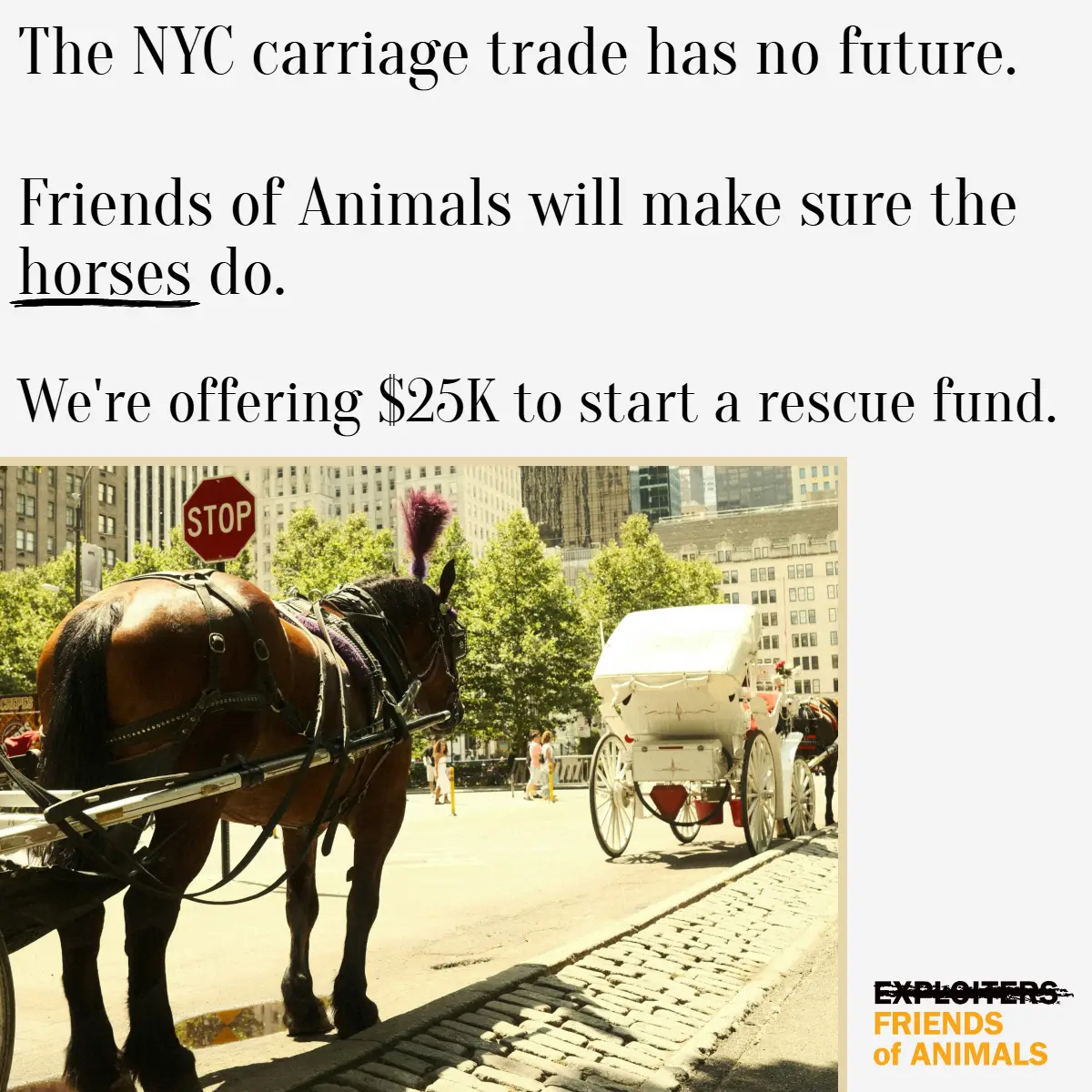
Rest assured, when Intro 943 becomes law, there is no question where the horses will go. Since the bill can be amended after the hearing, we support adding language that creates a fund to enable the city to facilitate a buyout of the horses from the owners and help with placement fees at the sanctuaries who need them. FoA can contribute $25,000 to start. We invite the TWU to engage with legislators and us on this. And we expect other groups to step up too.
At our own primate sanctuary in Texas, Primarily Primates, we have three rescued wild horses, so we understand the costs involved in providing lifelong care for equines. We also have enough space to accommodate some of the NYC’s carriage horses.
The carriage horse trade being deadly is not the only reason it needs to be banned—on a day-to-day basis it robs equines of their basic needs—adequate turnout for roaming free and socialization.
Simply put, while confined in NYC stables, horses are not allowed to be horses. If you are a horse person, you know why this matters. But if you’re not, here’s why.
Research shows that horses with regular turnout exhibit lower stress-related behaviors compared to those confined to stalls contributing to a calmer mind and body.
Not only does the carriage horse industry take away the very things these animals need to decompress, relax, or in other words, “get back to grazing,” they are then hitching a carriage to them and forcing them to pull it—along with unassuming tourists—into the loud, unpredictable environment of NYC.
Talk about a perfect storm.
The fact is, no matter what you teach the drivers, you can never teach a horse to unlearn the prey response. They are hardwired for survival. As an equestrian of 42 years, I know that even in the safest, calmest environments, horses may still freeze, bolt, or react defensively to sudden changes.
FoA understands why the industry sprang into action by shutting down briefly so the horse carriage drivers could undergo safety training after the teen was killed. And while that may have made the public and tourists feel safer, they aren’t.
And neither are the horses.