

By Nicole Rivard (appearing in the Hartford Courant August 26, 2026)
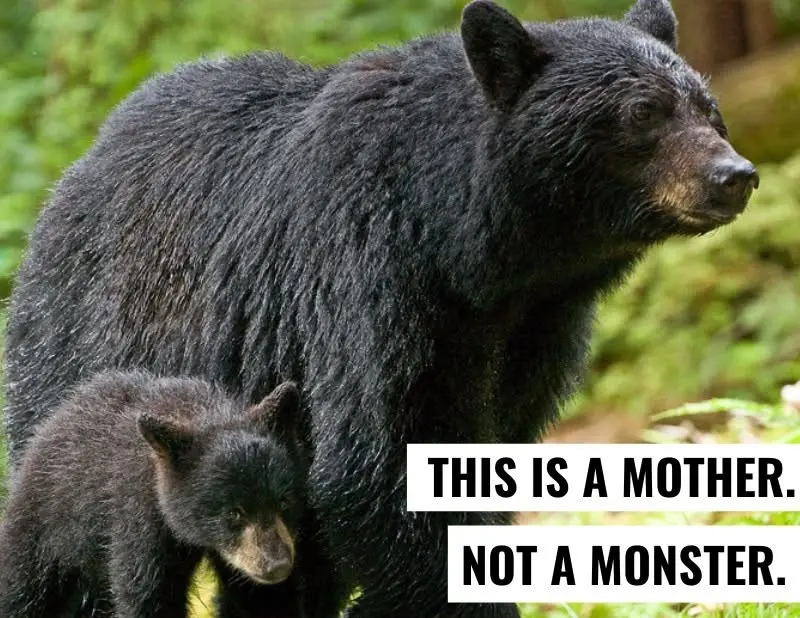
Connecticut doesn’t have a black bear problem. It has a problem with the way the media portrays bears.
CT’s black bears need a PR professional.
Because if they had one, the media wouldn’t have gotten away with sharing an edited video that created a narrative that a Torrington family’s dog saved their child from a charging bear in July.
A wildlife biologist Friends of Animals consulted with who saw the entire video said the bear was ambling up the walkway in the direction of the driveway, but it was quite a way away. Then the Husky spotted the bear and chased the bear towards the child. The bear even crashed into some things in the driveway to avoid the boy.
The Husky’s so-called heroism made national news and even People magazine. Unlike Connecticut’s black bears, Husky must have a good PR person.
Sadly, nothing spreads “bearanoia” faster than this type of misinformation.
The media will pivot between fear mongering to portraying bears as furry humans—it’s seemingly obsessed with sharing videos of bears’ “silly shenanigans.”
One recent video shows three bears “playing” on a swing set in Wolcott. Another shows a bear trying to get into a shed in Simsbury with these hashtags: #bears, #funny, #simsbury. Footage from New Hartford shows a bear “getting lunch from the birds” after it knocked over a bird feeder with the hashtags #bears #funny #newhartford.
Talk about mixed messages…and missed opportunities.
The media is missing out on crucial teaching moments that can keep bears and people safe. Like the fact that bears instinctively are shy and avoid people, but easy access to unsecured garbage, bird feeders, pet food, backyard chickens, livestock, feed, fruit trees and other human-provided food resources teaches bears that neighborhoods provide a more dependable source of easier higher calorie meals than foraging in the wild.
And if a bear is in your yard, from an open window or a safe place on your porch or deck, yell at the bear, bang pots and pans, blow a bear whistle or activate an air horn to let it know it’s not welcome. Don’t encourage bears to stay so you can watch and take videos to send to the media!
The Torrington incident underscores a very serious concern with interactions with bears and dogs lately, and how important it is to make sure dogs are kept on leashes if you live where bears live. The media didn’t mention that.
And don’t get us started on the bear home entry headlines.
They’re preventable. Year after year, residents living where bears live are leaving windows wide open—screens don’t keep bears out—as well as doors unlocked and wide open—according to reports from 2024-2025 secured from CT DEEP through a Freedom of Information Act request.
Connecticut is spending up to $500,000 on a survey of the state’s bear population, the first in over a decade. Perhaps that money would be better spent on helping towns like Colebrook and Warren provide bear-resistant trash cans to their residents, which both towns want to do. (Friends of Animals is working with them and USA Recycling to make it happen.)
A 2023 study in Seminole County Florida showed the use of bear-resistant containers (BRCs) reduced human-caused bear interactions by 54%, and bears eating garbage dropped to 0 percent. Calls to the Florida Fish and Wildlife Conservation Commission regarding garbage raiding, home entries, crop/livestock predation declined 40%. Durango, Colorado has had similar success—there was a 60 percent reduction in bears scattering trash and there was a 61 percent reduction in calls where BRCs were distributed.
The truth is scientific studies show a weak correlation between the population of bears and bear human interactions. They are more closely related to human behavior, according to the Journal of Wildlife Management.
It’s time to stop describing consequences of attracting bears as “bear problems” because it lets humans off the hook. And some people will expect the wildlife agency to “make their problem go away.”
Notably, researchers in states like Wisconsin and Nevada, as well as British Columbia, have revealed that killing black bears does not reduce so-called “nuisance complaints” because the bears visiting residential areas would not be targeted because it’s not safe to hunt there.
The only thing a bear trophy hunt will do is appease the desperate, miniscule 1% of Connecticut residents who hunt.
“If I wanted my state agency’s money and attention used in the best possible way to resolve the root cause of conflict over the long term, and not just put a band-aid on a bullet hole so to speak, it would be spending the time/energy/resources in working with city and county officials on removing attractants on the landscape, modifying garbage contracts to mandate bear-resistant containers, implementing ordinances on feeding wildlife (including birds, deer, etc.), and partnering on outreach/education programs,” said Rich Beausoleil, bear specialist for the Washington Dept. of Fish and Wildlife. “That I am quite certain would keep the two species separated in their own habitats.”
We at Friends of Animals couldn’t agree more.
Nicole Rivard is media/government relations manager at Friends of Animals.