

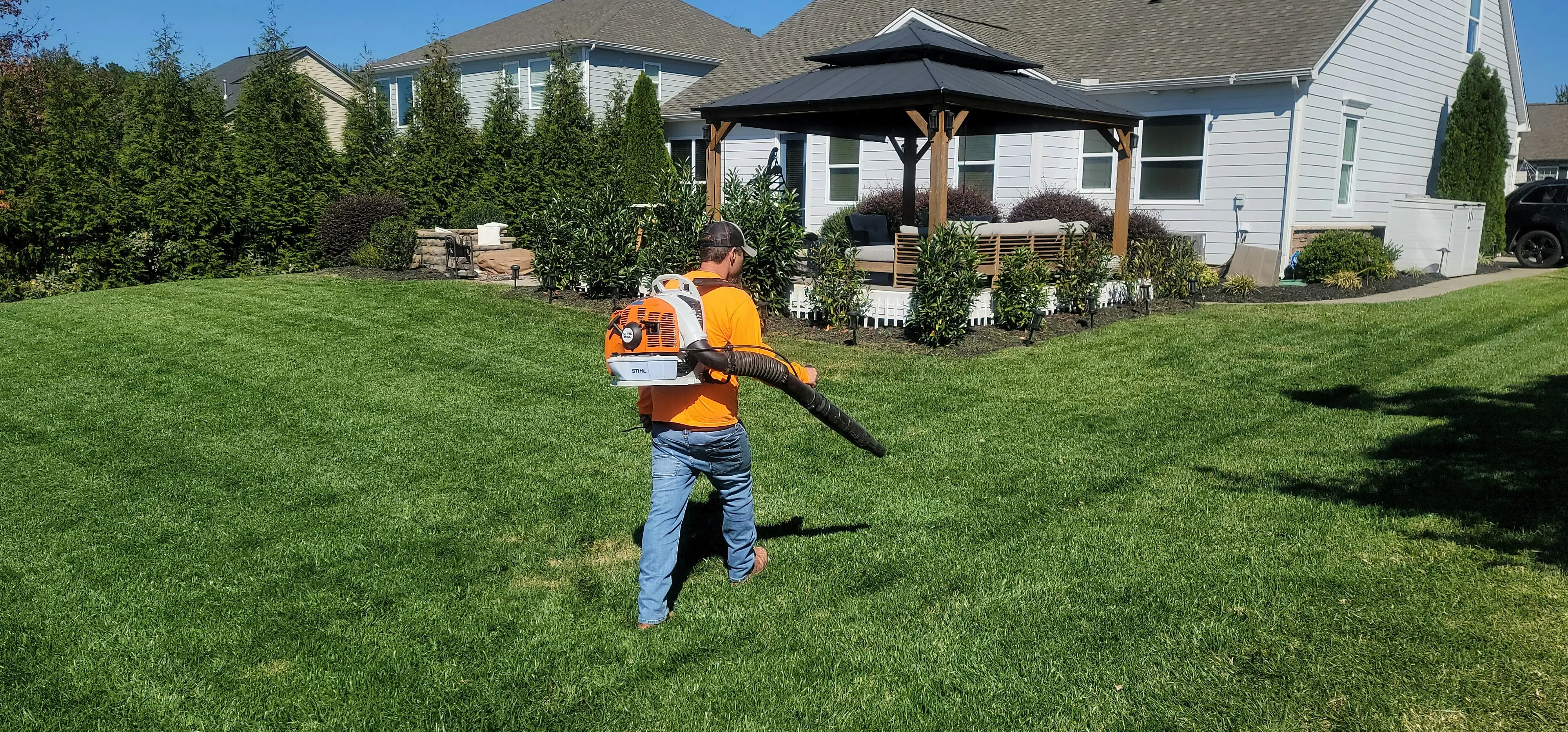
Earlier this week, the Friends of Animals’ headquarters in Darien, CT was bombarded by whooshes and whirrs and a plume of dusty, gassy matter.
In the yard next door were not one, not two, but six gas-powered leaf blowers issuing a coordinated attack on a negligible pile of leaves. The loud—they operate between 85-125 decibels, enough to permanently damage one’s hearing—and noxious smog machines proliferated plumes of dust and debris. After they were done, it wasn’t even clear what improvements had been made.
Yes, spring is finally here, and so too are the bane of our communities: gas-powered leaf blowers.
Leaf blowers are especially on my mind as I recently saw the actor Cate Blanchett on Subway Takes, a wildly popular “man on the street” sort of internet series where celebrities and civilians are seated on a subway and asked to defend one of their most strident opinions; “so, what’s your take?”
Blanchett’s take was that “leaf blowers need to be eradicated from the face of the earth,” which earned an enthusiastic “100% agree” from host Kareem Rahma.
Rahma goes on to tell a story of how, recently, in Miami he “literally saw a guy blowing one leaf.” So familiar, and so absurd.
Blanchett goes on to call leaf blowers “everything that’s wrong with our society.”
“We blow sh—from one side of our lawn to the other side, and then the wind is just gonna blow it back.”
That rearranging of leaves comes at a steep cost.
Gas-powered leaf blowers are well-understood to be super-polluters, for one thing; running a gas-powered leaf blower for 30 minutes emits the same amount of hydrocarbon emissions released by a Ford F150 driving from Maine to California, or Alaska to Texas. That’s a lot, especially when considering the U.S. uses approximately 11 million gas-powered leaf blowers each year.
And then there’s the noise. Gas-powered leaf blowers are incredibly loud, and noise pollution they emit often mettles with nature’s biological processes.
The same 85-125 decibel noise that threatens their operator’s ears occupies the same frequency range birds use to communicate, and when a bird’s ability to communicate isn’t available, that spells trouble.
A study conducted by Behavioral Ecology highlighted that birds exposed to continuous noise showed diminished responses to predatorial cues in nesting birds—their natural defense mechanisms were compromised due to noise pollution. A study published by Nature also found that noise pollution leads to reduced reproductive success in birds.
Despite all this wasteful pollution, one can’t help but wonder: what exactly are gas-powered leaf blowers even accomplishing? They’re known to harm the specific parcels of land they intend to maintain.
Leaf litter, what the blowers are after, isn’t something to be disposed of. It can act like a fertilizer that improves soil health, but it’s also a thriving micro-ecosystem; home to insects and overwintering pollinators; providing food for birds; and protecting ground-nesting animals.
But leaf blowers destroy these micro-ecosystems. A study in Science of the Total Environment found that removing autumn leaves in residential yards significantly reduces the springtime emergence of overwintering insects.
Leaf litter helps yards thrive—leaf blowers (even the electric ones in this case, despite paling in comparison to gas-powered in terms of its polluting potential) threaten that balance.
This spring, consider living and let live; and leaving the leaves alone.