

They “help support a healthy heart,” “support healthy joints,” and even “promote brain and cognitive health;” they’re fish oil supplements, touted to be rich in omega-3s, and they’re being widely consumed by unknowing Americans.
According to Harvard Heart Letter, a Harvard Medical School publication, fish oil is the second most popular supplement on the market. It’s taken by 19 million Americans, including one in five over the age of 60. They’re especially popular with consumers who dislike eating fish, but, bafflingly, think they ought to, so they opt for the supplements instead.
The heavy marketing is working and production of fish oil supplements is surging.
The supplements are made using krill, tiny shrimp-like crustaceans roughly the size of a thumb that are essential to the Antarctic ecosystem and the main food source for giant baleen whales (such as blue and humpback whales) as well as other Antarctic predators including penguins and seals. In addition to supplements, krill’s omega-3 rich oil is used in fishmeal for commercial animal and aquaculture feeds, in pet food, and as an organic fertilizer for soil enhancement.
In the past 30 years, the annual krill catch has quadrupled. In 2025, the catch reached a record, breaking a high set just one year before of 620,000 tons (the maximum allowed by the Commission for the Conservation of Antarctic Marine Living Resources).
Despite this astronomical figure, krill fishing is a relatively small industry. One company, Norway’s Aker BioMarine, is responsible for about 70% of the krill caught.
They operate exclusively in a relatively small, concentrated area of the Southern Ocean off Antarctica where krill are most abundant. Vexingly, these are essential whale feeding areas.
The whales were here first
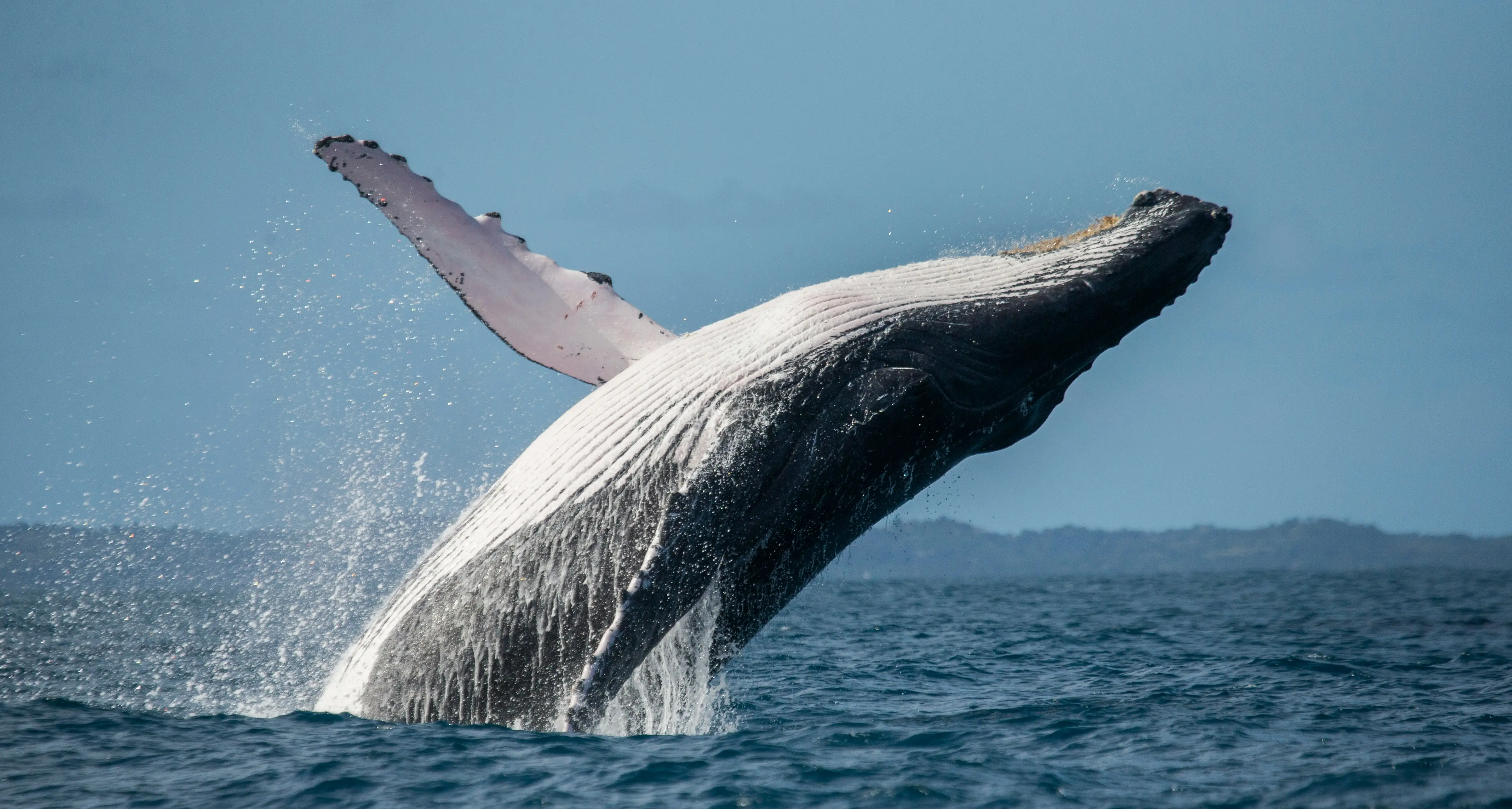
Baleen whales feed by taking in giant gulps of ocean water and filtering krill through their bristles; they target the densest swarms of krill and feed in megapods that can number in the hundreds.
Whales were brought to the brink of extinction during the 20th century when whalers slaughtered roughly 90% of all large whales in the Southern Ocean in just 50 years. Since then, they’ve rebounded, with some populations recovering to as high as 60% of what their pre-whaling populations once were. While their recovery has shown signs of progress, it’s still ongoing.
A 2021 study published in Nature found that the decline of baleen whales in the Southern Ocean also led to a decline in krill. According to researchers, the krill population must have been much larger, perhaps as much as five times greater than it is currently, in order to have supported the pre-whaling baleen populations.
This might seem counterintuitive: typically, when a predator is removed from an ecosystem, it leads to an abundance of their prey. But fascinatingly, when whales diminished, so, too, did the krill.
This happens because whales don’t simply eat krill, they recycle krill’s nutrients and fertilize the sea with their droppings, which provides nutrients for phytoplankton—what krill themselves eat.
This perfect food cycle provides an abundance of ecological benefits, too. In his study “Whale recovery and the emerging human-wildlife conflict over Antarctic krill,” Matthew Savoca noted that “krill are super important in the fight against climate change.”
Krill are fantastic at carbon sequestration and can remove as much as 20 megatons of CO2 from the atmosphere, annually, according to the NERDC. That is roughly the equivalent of removing five million passenger cars from the road for a year.
While whales and trawlers both remove krill, whale consumption of krill benefits the ecosystem. When a fishing vessel captures krill, and removes it from its environment, all of that phytoplankton feeding and carbon harboring potential is lost.
Krill trawlers also endanger baleen whales. The large, fine-mesh nets that drag through whale feeding areas sometimes trap whales along with krill. Nine humpback whales have died after becoming entangled in Aker BioMarine’s nets: Four during the 2021–2022 season, another four in 2023–2024, and one more in 2025.
If the goal is for whales and krill to recover to their pre-whaling populations, then whales must have uninhibited, abundant access to their food.
And still the krill fishing industry is rapidly expanding.
Savoca told FoA that this conflict particularly hinges on “how that krill is taken, which is to say right now the krill fishery is very concentrated in space and time.”
The implications are difficult to ignore: At a time when whale populations are still rebounding—and when they’re already facing pressures from warming oceans, ship strikes, and fishing gear entanglement—diminishing access to food could prove especially devastating.
Fish oil or ‘snake oil?’
Frustratingly, much of this destruction is being driven by companies marketing products with health claims that remain deeply contested.
The FDA considers dietary supplements, like fish oil to be food, and not drugs. Therefore, they aren’t required to undergo the same rigorous testing that clinical drugs must.
People take fish oil primarily, to combat heart disease. They’re drawn to the supplement because it’s said to be rich in two of the three omega-3 fatty acids — eicosatetraenoic acid (EPA) and docosahexaenoic acid (DHA) — that are commonly found in fish. The third is alpha-linolenic acid (ALA), which is found in many plants including seeds, nuts, and green vegetables. The body can convert a small amount (~8% of dietary ALA into EPA and DHA)).
A 2023 Harvard Medical School investigation found that many available fish oil supplements were produced via a process that leaves omega-3 fatty acids exposed to uncontrolled heat and oxygen, which can result in oxidation of fatty acids. When oxidized, the oils no longer contain any biological benefit, and consuming oxidized oil has also been linked to vascular inflammation—a key cause of cardiovascular disease. So, instead of warding off heart disease using fish oils, consumers might actually be inviting it in.
Vegans can get their omega-3’s elsewhere. Many plants contain ALA, and the body can convert some ALA into EPA and DHA. But, even more conveniently, Algae oil is rich in EPA and DHA; it’s how fish get their omega-3’s, and there are plenty of vegan omega-3 supplements on the market that are produced using algae oil, some of which are listed below.
Vegan Omega-3 Supplements
- Future Kind Vegan Omega-3 comes in eco-friendly packaging.
- Nordic Naturals Algae DHA is a good value pick.
- Performance Lab Vegan Omega-3 is more potent than fish oil.
- Freshfield Vegan Omega-3 has some of the most DHA per serving on the market.
- Zenwise Vegan Omega-3 is another great budget option.
- Barlean’s Omega-3 comes in a fruit-flavored liquid.
- Garden of Life Algae Omega-3 is a classic option.