

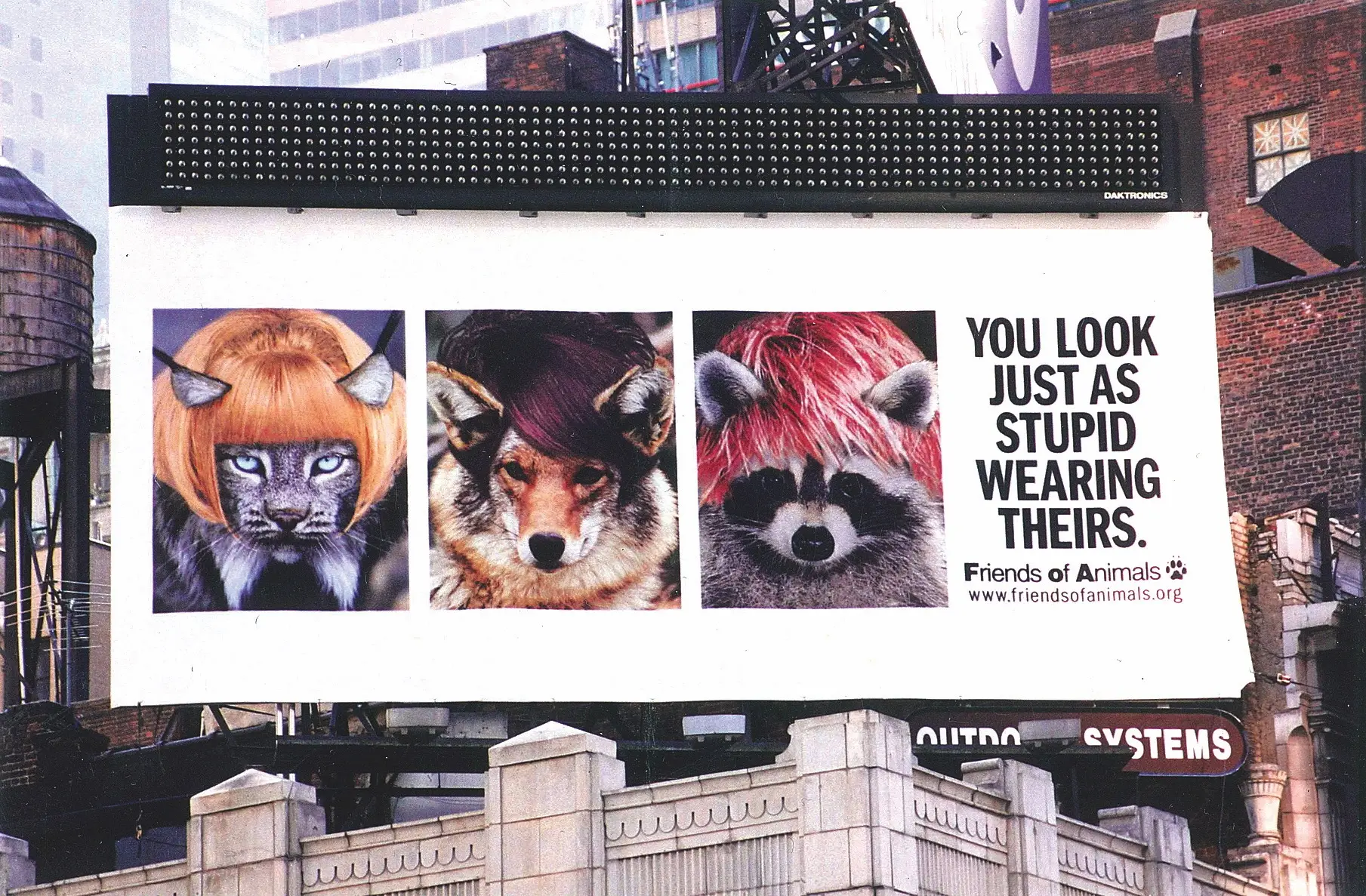
It’s Fur-free Friday—a reminder not to buy into industry’s tricks of the trade.
Four years ago, Macy’s became the biggest U.S. retailer to phase out the sale of animal fur. That included its NYC Fur Vault Salon, where Friends of Animals held a protest in December 2014. We urged customers to make the connection between fur coats and the animals who were skinned to make them during a busy holiday shopping day.
FoA President Priscilla Feral vividly remembers our annual NYC Fur Free Friday demonstrations, especially the one in 1998 when the fur industry spent big bucks to convince the public and media that “Fur is Back.” However, the truth was that fur sales peaked in 1987 and hit their lowest level in 1991, and while there had been a small rise in sales, fur was still struggling. We headlined an article about fur in our quarterly magazine “Fur is back. So is Elvis” accordingly.
With the media out in full-force, hundreds of animal advocates gathered to protest Saks’ fur sales. (In April 2021, Saks Fifth Avenue announced it would phase out using fur by the end of 2022.) Thousands of holiday shoppers got the message—fur is cruel and anti-fur sentiment is alive and well. A ragtime band played while protestors dropped discarded furs on a “rag” pile at Saks front door. Other activists dressed as Neanderthals handed out leaflets reminding people that “Fur is a Thing of the Past” and urged them to “Evolve.” This same message was seen on the sides of buses.
From Saks, demonstrators marched up Fifth Avenue and eight sat down in front of Revillon Fur Company blocking the entrance. As police moved in, another 12 showed up bound together by steel pipes. It took almost six hours for the police to cut through the pipes.
Needless to say, no one was buying any fur at Revillon that day. Instead, because of media coverage, millions of viewers had an opportunity to think about the cruelty that is fur.
Don’t be fooled by trims & pom-poms—dead is dead
The good news is, the U.S. fur industry continues to shrink, which goes to show what activism has made possible. Not only have consumers, the biggest names in fashion in the U.S. and the largest retailers heard us loud and clear and stopped buying, using and selling fur, in 2023 California’s ban on the sales of newly made fur products, with the exception of those produced by Native American tribes went, into effect.
California’s fur sales ban puts another nail in the coffin of the fur industry. Because together, California and New York made up nearly 43% of all fur sales in the country in 2017, according to the latest U.S. Economic Census. U.S. retail sales of fur garments totaled just over $574 million, with most sales occurring in California at just under $129 million, followed by New York with almost $115 million. (The 2024 U.S. Economic Census has not been released yet.)
But when you are an industry that raises animals on fur farms and that traps wild animals for the sole purpose of skinning them so people can look a certain way, of course you must be prepared to be met with disgust. That’s why the fur industry is notorious for renovating its image and ramping up its feel-good messaging when the going gets tough.
The fur industry’s contemporary design and cutting technologies have changed the look and texture of fur, even making it appear fake. In some cases, bright dyes have been applied. Bits and pieces of pelts, those “scraps” that once were part of a breathing being—show up on garments and accessories in new ways, as though fur were a versatile fabric.
They’re targeting consumers who would never wear a full-length coat, but they might not feel the same about a fur-trimmed jacket, or handbags, shoes or beanies adorned with real fur pom-poms.
Sadly, beanies with real fur pom-poms have become ubiquitous in Farfield County, Connecticut, where FoA is headquartered.
And fashion editors have touted the real fur pom-pom, saying it represents “the perfect Christmas fad storm” because they strike the balance between jaunty, upbeat fashion befitting of the season and look stylish. One editor said they are “an inherently cheery, festive thing, and tis the season for all of that.”
That myopic view tells us there is still more work to be done. We must continue to educate people about the fact that buying any amount of real fur, no matter how small, means sustaining an industry that farms or traps, kills and processes animals who could have lived full, free lives.
FoA has always known that if we don’t speak up for fur-bearing animals—such as minks, foxes, coyotes, raccoons, and lynx— by talking about their suffering and exploitation, the fur industry will.
To make a fur coat, it takes 15-40 foxes, 50-60 minks or 150-300 chinchillas.
There’s nothing cheery or festive about that.
Nicole Rivard is media/government relations manager for Friends of Animals.