

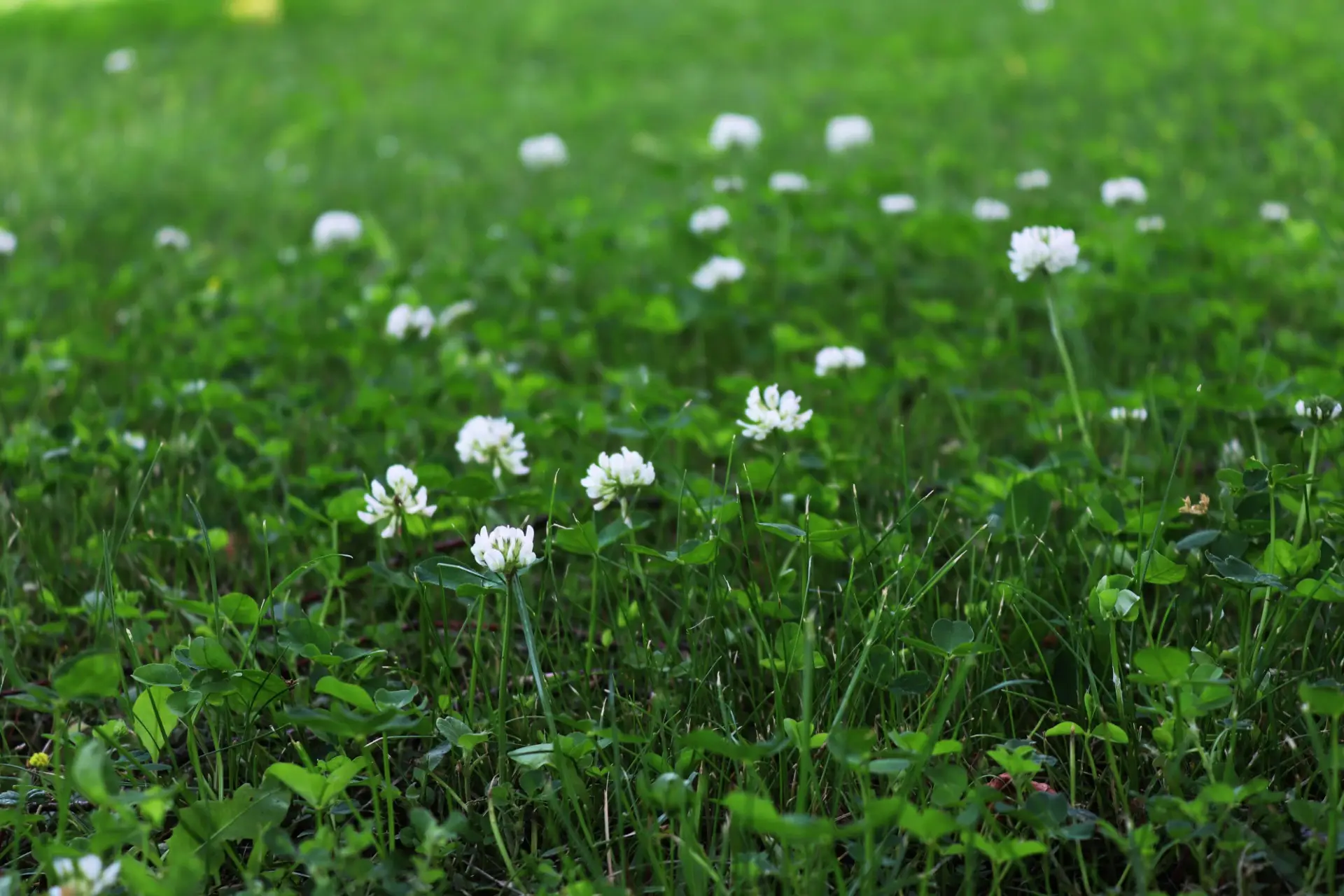
Recently I was at my parent’s house helping them open the pool and get the backyard ready for summer. I relished walking around barefoot in the grass. It struck me how much cushiony, lush white clover we have these days.
And that’s a good thing for pollinators. More on that later.
In the 80s, when we didn’t know about the dangers of toxic pesticides, herbicides, and fertilizers to pollinators, wildlife, humans, and pets, my family hired a company called Chemlawn (now TruGreen), which was founded in 1968 by sod farmers and garden center owners and Ohio. Even the name embodies a business plan with sole dependency on toxic synthetic chemicals.
YIKES.
But it was another company, about 20 years prior, that first committed a crime against nature by introducing its Weed and Feed, a mixture of the herbicides, 2,4-D or mecoprop and synthetic fertilizer—nitrogen, phosphate, and potassium. It set the precedent that the public didn’t have to rely on nature to deliver nitrogen through organic matter and soil biology that cycles nutrients naturally.
“Scott’s was part of a cultural revolution that turned lawns of grass, wildflowers, and clover into monocultures of green carpets, mixing synthetic fertilizers and pesticides to kill weeds before they could germinate and tamp down fungus. Everything was put in the bag—Scott’s 4-Step program,” writes Jay Feldman, president of Beyond Pesticides, in the organization’s Pesticides and You journal.
It’s frightening no one was questioning taking chemicals used as weapons of World War II and integrating them into consumer pesticides!
In 2020, Beyond Pesticides filed a lawsuit against TruGreen for advertising to consumers that it offers environmentally friendly, sustainable lawn care services that use no chemicals that may cause cancer, allergic reactions, or other health or environmental harms. Beyond Pesticides argued that the claims were false and deceptive and illegal under the laws of the District of Columbia. The organization reached a settlement in the case after TruGreen agreed to modify or remove certain marketing statements at issue in the lawsuit.
Times they are a changing
Thankfully through rising awareness of consumers about the chemicals put on their lawns, they are interested in more natural solutions such as organic lawncare.
And Beyond Pesticides is happy to oblige. Their website, beyondpesticides.com, is chock full of info to help people make informed choices and adopt practices that protect themselves and their families—and nature— from unnecessary exposure to pesticides.
And that brings me back to the misunderstood and beneficial broadleaf plant in the legume family: clover.
For a longtime many homeowners saw clover as an unwanted weed. However, it is having a surprising moment, says a recent article in House Beautiful.
Here are some just some of the reasons we compiled to add clover to your lawn or switch to an entire clover lawn. Though red, crimson and white are the most familiar, it is white, or Dutch, that is best suited to be incorporated into lawns:
· Clover is a buffet for declining pollinator populations like bees, butterflies, and other helpful bugs. The flowers bloom for weeks. A 2014 study in the Journal of Insect Conservation on species richness in mixed clover lawns in the Lexington, KY metro area documented more than 200 pollinator species over the course of a spring sampling, including approx. 21 different species of bees. On average each lawn contained up to 12 pollinator species.
· Clover is a legume—bacteria in its roots pull nitrogen from the air and feed it to the soil. That means clover provides your lawn with enough nitrogen to eliminate any need for ecologically hazardous synthetic fertilizers.
· Clover crowds out weeds without herbicides.
· Clover handles heat better than grass. When summer heat sends grass into dormancy, clover stays green. White clover holds its color through dry summers.
Extended heat waves may still call for a deep watering, but clover still bounces back better than grass.
· Clover needs almost no mowing. A pure white clover lawn only needs to be mowed less than 4 times a season.
· Clover attracts earthworms and other beneficial soil microorganisms. Its roots break down into the soil and create tiny channels for water and air.
Many garden centers and hardware stores now carry clover seed, and it can also be purchased online.
Nicole Rivard is media/government relations manager for Friends of Animals.