

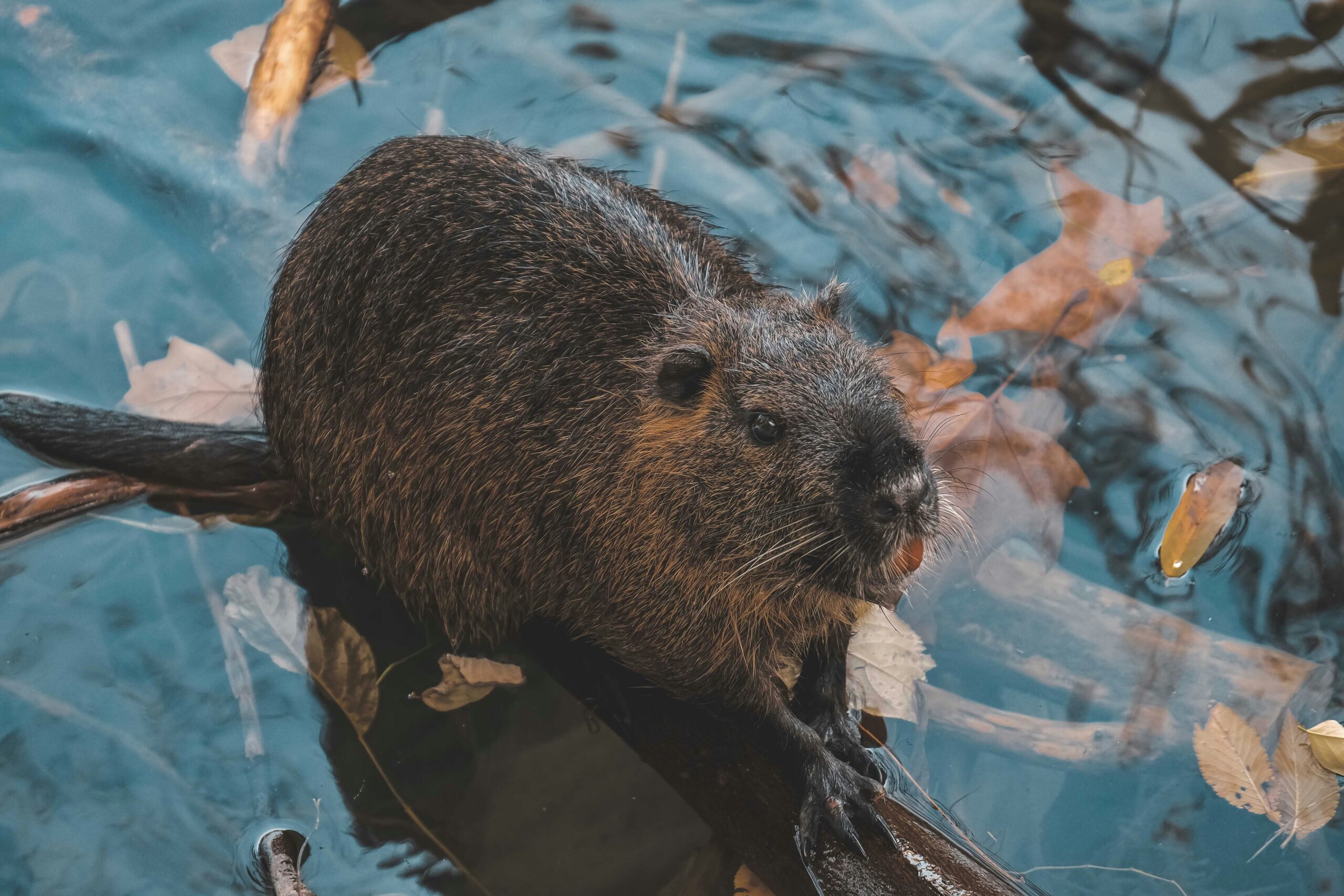
If you’ve ever taken a hike through the woods and stumbled across a dam, you’d instantly know it: a beaver was here. But did you also know that if you’ve sauntered through a wetland or a meadow, chances are, you’re witnessing more beaver handiwork?
Aptly referred to as Nature’s Architects, beavers are responsible for shaping our North American landscape in profound ways.
When they once numbered in the hundreds of millions on this continent, beavers created over 300,000 square miles of wetlands. Their dams slowed rivers and created habitats for amphibians, fish, reptiles, and other wildlife. Ecosystems thrived thanks to these builders. That was before fur trapping European colonists arrived, pushing beavers to the brink of extinction.
Beavers were exploited for their fur, and their pelts became one of the most sought-after commodities in the world, decimating populations. By the turn of the 20th century, beavers were scant. Pennsylvania became the first state to protect beavers in 1903, and hunting regulations combined with re-establishment programs formed since have helped beavers bounce back.
Today, beavers’ influence on their ecosystems is well-understood. They’re hailed as a keystone species, meaning the impact they have on their environment is disproportionately large relative to their abundance. Recently, they’ve even been in the spotlight for their ability to safeguard land from wildfires.
The fur trade is not nearly what it once was. Yet still, beavers are being subjected to preposterous threats, this time from state wildlife agencies and myopic-thinking landowners.
In New York—whose state animal is the beaver, ironically—is actively encouraging residents to go out and kill more beavers, claiming “beaver activity is causing damage to roads, trails and other features.” In Wisconsin, Wildlife Services is contracted to kill beavers year after year to appeal to hasty landowners. And in other states, landowners are allowed to kill a “nuisance” beaver if it tampers with their property.
Colorado is one such state. Colorado Parks and Wildlife (CPW) currently allows landowners to kill beavers in many circumstances, without needing as much as a permit. This is even though CPW doesn’t have any data, only rough estimates, on how many beavers are being killed per year, and despite their rhetoric encouraging coexistence with beavers.
Time after time again, those charged with stewarding beavers turns their back on them in favor of uncompromising humans.
There is, for now, a bit of good news.
CPW recently asked the public for input on a newly drafted Colorado Beaver Conservation and Management Strategy. Along with some recommendations, Friends of Animals’ Wildlife Law Program (WLP) submitted comments enthusiastically supporting the strategy’s purpose.
WLP supports the strategy’s intentions to “increase prevalence of beaver and beaver-influenced wetlands,” and “increase beaver populations.” We especially supported the strategies goals of “reducing lethal take and promoting co-existence with beavers,” although, in our comments we strongly urged CPW to use its authority to eliminate beaverkilling and trapping.
WLP went on to support some of the more comprehensive aspects of the strategy, especially those that serve the needs of individual beavers. This, for example, includes prohibiting dam removals when its difficult for beavers to find new homes and gather a food cache.
Ultimately, we’re encouraging CPW to do what real conservation requires: ending policies that cater to human inconveniences and allow killing.
This shouldn’t be controversial.
In fact, to show how obvious this should be, here’s a list of roles, values, and benefits beavers pose in their ecosystems:
- Capture and storage of snowmelt and spring rain, and recharge of rapidly depleting aquifers leading to sustained stream flows through the dry summer and water security for agricultural operations, cities, and wildlife, which is becoming more critical as climate change causes more aridification and decreased snowpack
- Filtering of sediment and pollutants, including nutrients, behind dams, resulting in clean flows below and helping to decrease the potential for algae blooms
- Protection from, and reduced severity of, wildfires by increasing the size and abundance of natural firebreaks
- Erosion control through slowing flows, thus preventing incision and rebuilding incised streams and valleys
- Dissipation of floods in beaver ponds and associated wetlands and connected floodplains
- Creation of complex and diverse mosaics of habitat and associated resilience to climate change and other disturbances for many fish, mammals, birds, amphibians, reptiles, invertebrates, and plants
- Opening of forest canopies to stimulate photosynthesis and the growth of phytoplankton that form the base of aquatic food webs
- Cooling of stream temperatures through increased groundwater inputs and deeper water depths, allowing more cold-water fish to survive
- A nature-based climate solution in the form of long-term capture and storage of carbon in beaver meadows and wetlands