

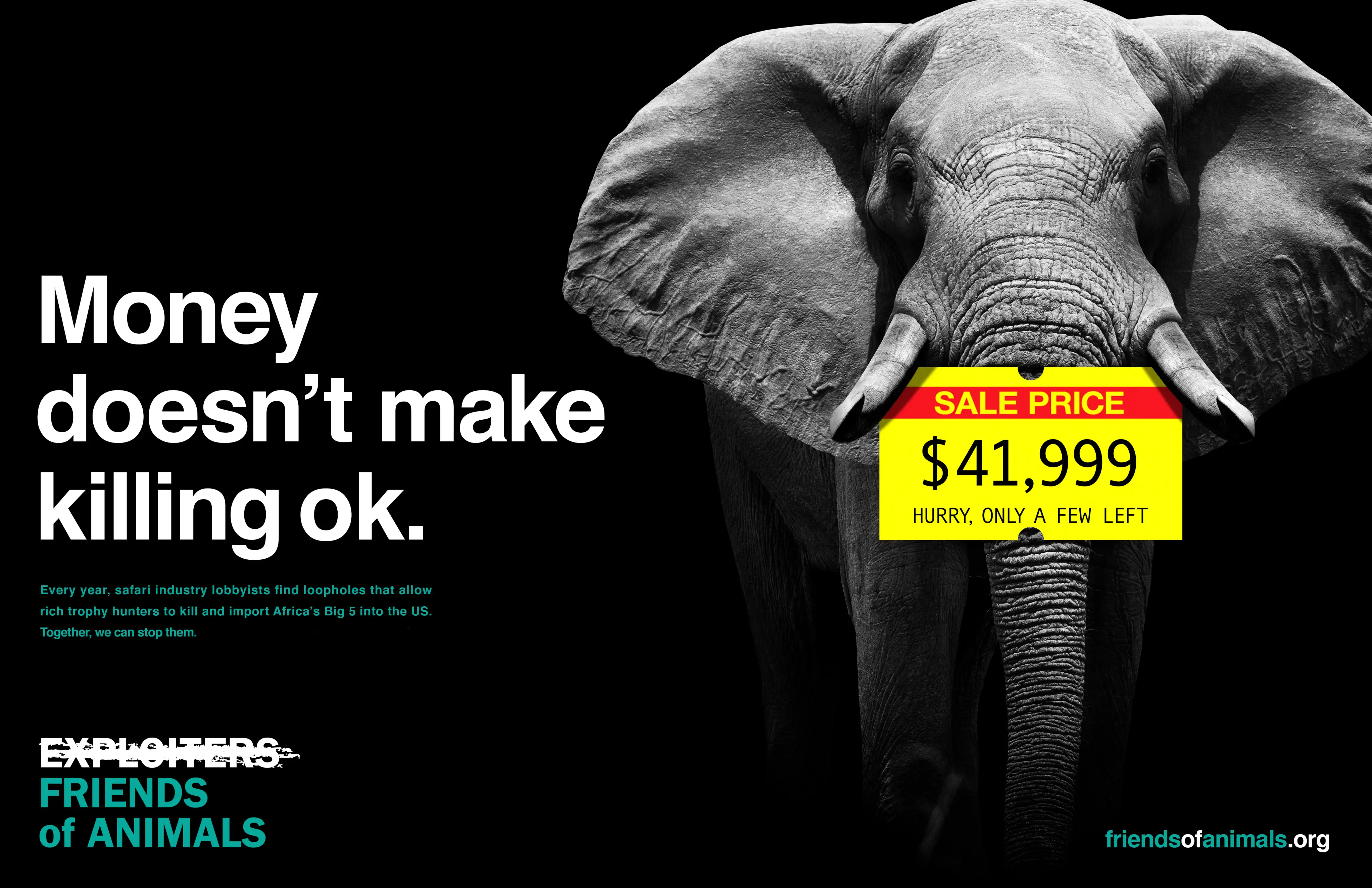
Jeers to the Trump Administration for allowing the trade in elephant trophies to soar in 2025.
Three hundred elephants were slaughtered so their body parts could be imported into the United States in 2025, according to a Freedom of Information Act request submitted by the Center for Biological Diversity. This compares with 114 elephant parts registered as imported in 2018 under Trump’s first term.
Any elephant killed and imported by vainglorious U.S. trophy hunters to hang on their walls of shame disgusts us. That’s why in 2021 Friends of Animals filed a rulemaking petition with the U.S. Fish and Wildlife Service to stop the importation of the sport-hunted “trophies” of threatened and endangered animals.
“If the goal of the Endangered Species Act is conservation of species, our regulations should not grant a loophole legalizing the slaughter of the most vulnerable among them and then add insult to injury by permitting the glorification of the killing through the importation of their dismembered body parts,” said Steve Hernick, managing attorney for Friends of Animals Wildlife Law Program.
“Permitting individuals to hang lion and leopard heads or mount elephant tusks on the walls of their homes, for example, undermines the message that we should be protecting them.”
The majority of the elephant trophies in 2025 – 65% – came from Botswana. The southern African nation reopened trophy hunting on its land in 2019 after a pause of five years. In 2026, it has licensed an increased annual trophy hunting quota of 430 elephants.
FoA’s petition points out that FWS blindly equates money spent on a trophy hunt with enhancement of the propagation of a species, ignoring evidence to the contrary—studies show that trophy-hunting programs are grievously damaging species such as elephants and lions. The petition shows that trophy hunting encourages poaching by reducing the stigma of killing these animals and providing poachers with a way to camouflage their parts. It also reveals trophy hunting has disturbing sociological effects on hunted populations and interferes with natural selection by removing a species’ strongest and healthiest animals from the gene pool, leaving threatened and endangered animals more vulnerable to extinction.
“Killing is not conservation,” said Priscilla Feral, president of FoA. “Banning the importation of the body parts of species who are ecosystem engineers, climate change combaters and apex predators crucial to ecosystems and helping to increase their populations is conservation.”
Rest assured, we won’t stop our efforts until trophy hunting is dead.