

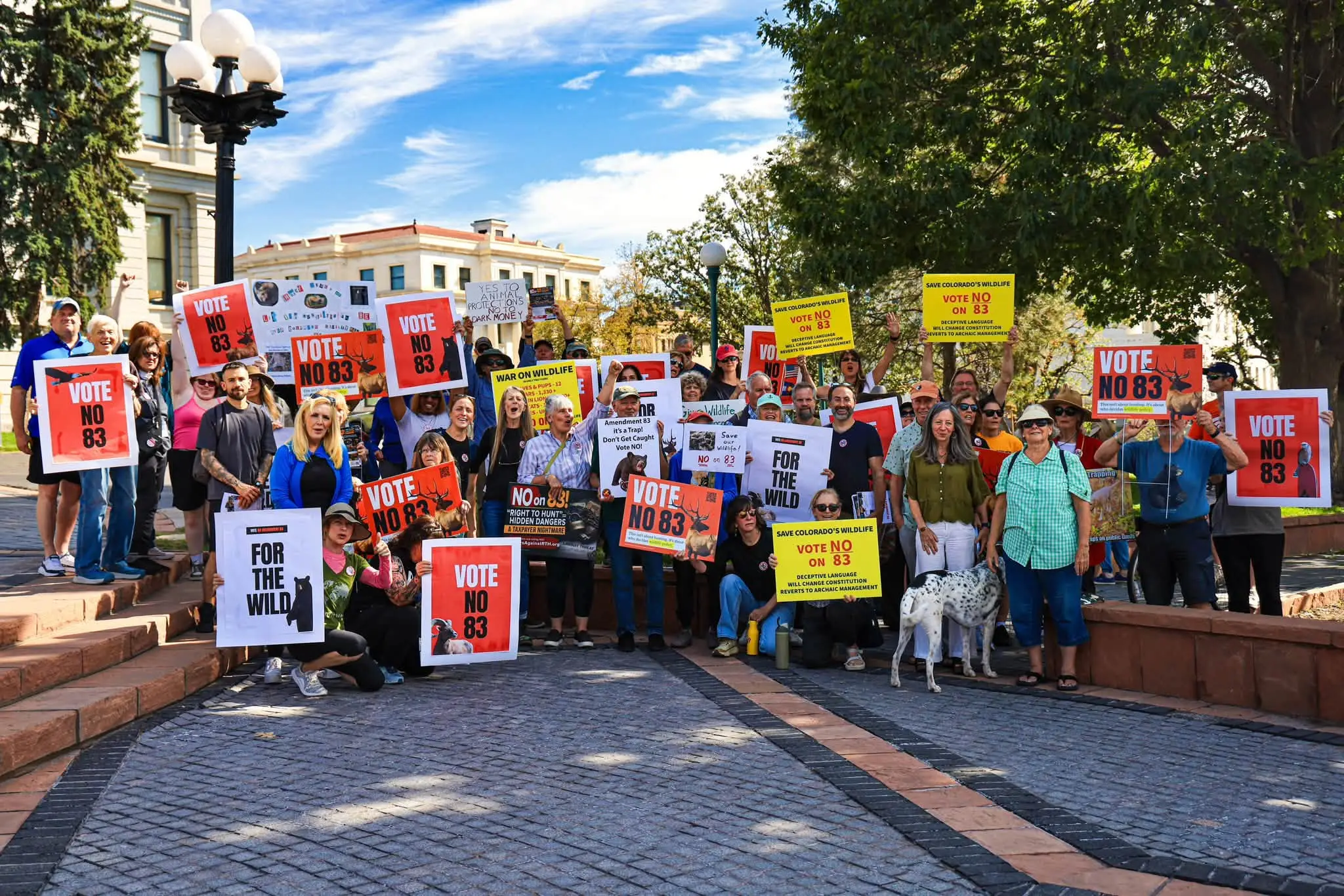
Colorado already allows hunting and fishing. So why is there a ballot initiative to establish killing wildlife as a right?
Amendment 83, appearing on Colorado’s November ballot as an initiated constitutional amendment, would establish a constitutional right to hunt and fish in the state.
Friends of Animals is urging our Colorado members to vote No on Amendment 83. A yes vote would leave lasting, high stakes change to Colorado’s Constitution.
Colorado’s Amendment 83 bills itself as a so-called “Right to Hunt and Fish” measure. What more “rights” do they need, though, in a state where hunting and fishing are already fully legal?
Framing the Amendment as just another “right” in need of protection dilutes its truer, harsher motivations.
Amendment 83 sneakily seeks to enshrine hunting and fishing the “preferred” means of wildlife management. A “yes” vote would tie the hands of wildlife biologists
Bits of the amendment’s intentional vague language don’t stop there. Amendment 83 guarantees the right to hunt and fish by “traditional methods.” Friends of Animals can’t help but wonder what exactly does that mean?
Does it mean bringing back wildlife killing contests? Colorado banned cruel wildlife killing contests, where participants compete to slaughter the most animals for cash prizes, in 2020; but “traditional methods” could mean anything.
Does “traditional methods” mean bringing back garish, indiscriminate leg hold traps, which have been banned in the state since 1996?
Does it mean bringing back a bear baiting, which effectively turns innocent wild bears into habituated targets, and has been banned in Colorado since 1992?
FoA also wonders whether large swaths of nature will be off limits for those who don’t make killing a hobby. Outspoken opponents have already begun to worry that Amendment 83 will give hunting and fishing preference over other forms of outdoor recreation, and firearms being introduced to areas previously unallowed, resulting in more places being closed off.
Will photographers who ‘shoot’ bears be made to stay home because someone with a gun was guaranteed the right to do the other kind of shooting?
This is much more than a simple policy change; once locked into the Constitution, it can’t be easily adjusted when wildlife inevitably suffers.
Friends of Animals strongly opposes Amendment 83, Colorado’s so-called “Right to Hunt and Fish” measure. Colorado already allows hunting and fishing. This amendment is about giving people who kill wildlife even more power over animals who never get a vote.
Under Amendment 83, hunting would become carte blanche. A constitutional amendment is the state’s highest law; while statute can be fixed if it turns out to have unintended consequences. A constitutional amendment can’t; it would take another statewide vote, with a 55% supermajority, just to correct a mistake.
If passed, state agencies and the General Assembly could still regulate hunting, fishing and wildlife management, but only if the law is “necessary” for sound scientific wildlife conservation and management, public safety, or preserving future hunting and fishing opportunities.
That could leave critical questions for courts to resolve when regulations are challenged. What qualifies as “necessary”? What constitutes “sound scientific” management? And who ultimately decides whether a wildlife regulation meets that standard?
Colorado’s Constitution is not a trophy room, and wild animals are not targets, props, or “resources” to harvest.
Amendment 83’s supporters clearly see things otherwise.
Amendment 83 is part of a national, well-funded agenda led by major trophy hunting groups—such as Safari Club Interational,Wisconsin-based International Order of T. Roosevelt (IOTR), and the NRA—and one geared toward permanently changing how the state manages wildlife.
IOTR specifically openly states that its mission is to establish constitutional rights to hunt and fish in all 50 states.
24 states currently have “right to hunt and fish” provisions, 23 of those 24 provisions were adopted after 1996.
In 2023, IOTR launched simultaneous campaigns in Florida, Iowa, Ohio, and South Dakota. Florida voters adopted a similar constitutional amendment in 2024, making Florida the 24th state with a constitutional hunting-and-fishing provision.
If Amendment 83’s language enters the constitution, Colorado would be the 25th. And the cost of getting this wrong will be paid by Colorado’s wildlife and ecosystems.
Vote No on Amendment 83.