

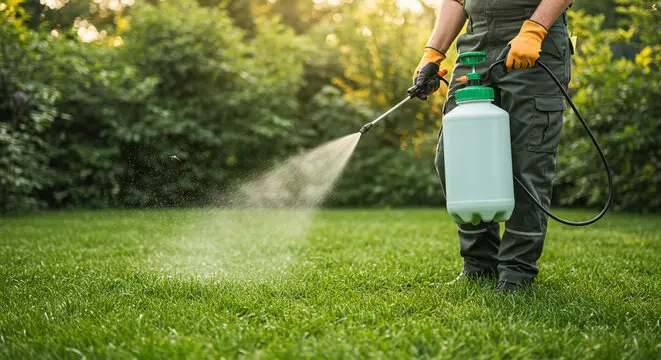
Recently an FoA staff member saw a man in the road at the end of his driveway spraying herbicides on a weed that had dared to pop up through the asphalt. It was alarming to see he was so fixated on killing weeds that he felt compelled to do it outside his own yard.
Not to mention lawns flexed with so-called weeds like purple thyme, yellow dandelions, and white clovers attract attracted pollinators, fireflies, beneficial insects, etc.
What’s even more horrifying is that the companies that want to keep people like him addicted to the herbicides that will give them the perfect, weedless lawn—despite the fact the poisons also harm humans, the environment, and any living thing in their path—were handed a huge boost by the Supreme Court last week.
On June 25, in a 7-2 decision, the Court issued a ruling that prohibits, under current federal law, the right of those harmed by pesticides to sue manufacturers for their failure to warn consumers of potential hazards on their product labels. The decision effectively shields manufacturers from failure to warn lawsuits. The Supreme Court case, Monsanto v. Durnell, pit the manufacturer of the weed killer glyphosate, sold as RoundupTM, against a cancer patient with non-Hodgkin Lymphoma who was awarded $1.25 million in 2023 because the product label information provided no warning.
The Court’s decision is preceded by thousands of successful lawsuits and settlements against Bayer/Monsanto for the company’s failure to warn about long-term hazards on their RoundupTM product label. While EPA does not recognize glyphosate to be cancer-causing, the International Agency for Research on Cancer, a branch of the World Health Organization, finds it to be “probably carcinogenic to humans.”
The decision will vacate, or undo, billions of dollars in jury verdicts against Monsanto.
Before the Supreme Court heard the case on April 1, a statement decrying chemical company secrecy was released by over 200 grassroots, health, farm, farmworker, environmental, and consumer groups, socially responsible corporations, over 385 citizens from 47 states and the District of Columbia, and international partners, according to Beyond Pesticides, a national health and environmental group.
With support of the Trump administration, Bayer/Monsanto argued it should not be required to disclose on its product labels the potential cancer hazards of its pesticide products.
“The Court’s decision is a tragic setback for public and environmental health, allowing companies that produce toxic pesticides to evade the most basic of responsibilities, warning consumers that their products may cause cancer and other deadly diseases,” said Jay Feldman, executive director of Beyond Pesticides. “In an age of deregulation, the ability of farmers, farmworkers, and consumers to hold chemical manufacturers accountable for hazard warnings is the keystone to minimum protection of public health, as demand in the market for the safest possible products grows daily,” Feldman continued.
Just say no to Roundup & other toxic herbicides
This stunning Supreme Court ruling should come as a reminder to people to stop using toxic herbicides. While Monsanto/Barer phased out glyphosate-based herbicides for the U.S. residential lawn and garden market in 2023 (it still produces and sells it for agricultural and professional uses), the truth is the company just replaced glyphosate in Roundup with combinations of four chemicals, two of which are banned in the European Union, according to an analysis by Friends of the Earth.
The group identified eight Roundup products in which Bayer has replaced glyphosate with combinations of four different chemicals: diquat dibromide, fluazifop-P-butyl, triclopyr, and imazapic. All four chemicals pose greater risk of long-term and/or reproductive health problems than glyphosate, based on the EPA’s evaluation of safety studies. Diquat dibromide and imazapic are banned in the EU. Diquat dibromide—present in all the new formulations—is 200 times more toxic than glyphosate in terms of chronic exposure and is classified as a highly hazardous pesticide.
The chemicals replacing glyphosate in Roundup are significantly more likely to harm bees, birds, fish, earthworms, and aquatic organisms, on average. They are also significantly more persistent in the environment and more likely to leach down into groundwater, increasing the risk of contaminating waterways and drinking water.
Safe weed management
Petrochemical companies convinced the public that grass looks good. We need to get over the obsession with the perfect lawn. Poisons and the “perfect” lawn mean no insects, no birds and no wildlife. Weeds on a lawn, park or athletic field should absolutely be tolerated. If there truly is a weed infestation overtaking turfgrass, that is a sign of unhealthy soil.
If a weed must go, we like these non-toxic tips from our allies at Beyond Pesticides.
• Hand pull weeds when the ground is moist. Be sure to remove vegetative parts to prevent re-sprouting. Tools and machines are available to make pulling easier. For example, a standard hoe, and a trowel can work wonders. Products like Fiskars Uproot Weeder, Garden Weasel Weed Popper Step and Twist, or Grandpa’s Weeder can be used on a variety of weeds. Peaceful Valley Farm Supply sells several.
• Flame weeding machines use a targeted flame to kill weeds (and can also be used in the winter to melt ice!). Some examples of handheld flamers include Red Dragon (Both Mini, Full Sized and Backpack Kits for Larger Areas).
• Boiling water and high-pressure steam both work to kill weeds as well, yet not as effectively as flame weeders. These are a better option in areas where an open flame may be hazardous. Most steam weeders are only commercially available. But you can do it yourself