

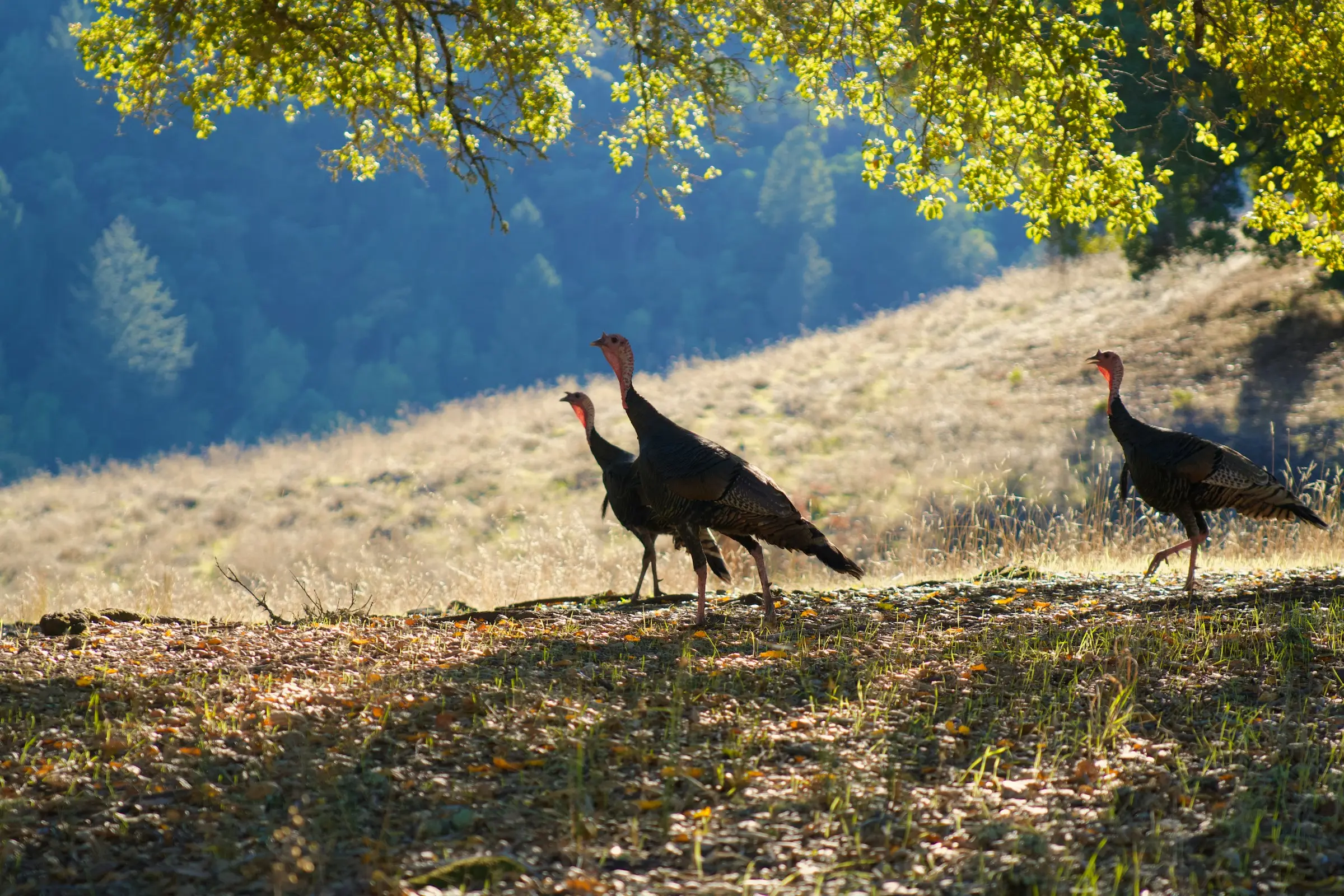
November is often referred to as the season of gratitude, stemming from it being the end of harvest season, a time when farmers traditionally gave thanks for the year’s yield.
If you live in New England, where Friends of Animals is headquartered, and you’re dazzled by the display of trees changing color, or perhaps the first light snowfall, it’s easy to be thankful for the natural world in general.
We especially look forward to seeing turkeys this time of year…and we mean in the wild, not giant inflatables in people’s yards or on a dinner table at Thanksgiving. (Check out our vegan Thanksgiving menu here.)
Wild turkeys can be spotted in rural forested and urban areas. This time of year, our backyards present opportunities for turkeys to roam and pick on grubs and acorns.
You’re likely to see more birds now than in spring or summer. While turkey breeding season starts in late March and early April when male turkeys begin gobbling and displaying for the hens; in the fall, turkeys gather for the winter and start building up their winter flocks.
Even though turkey motifs are ubiquitous this time of year, it’s likely most people don’t know what really makes them so remarkable:
• They are survivors. Thanks to innate skills and mental prowess, wild turkeys can outsmart their natural predators such as foxes, coyotes and raccoons. When they hear something suspicious, they will often freeze in place and remain silent to avoid being detected. And they use camouflage to hide in the underbrush, where their mottled brown and black feathers are difficult to spot by predators.
• Turkeys can detect movement instantly because they have excellent eyesight, seeing three times more clearly than 20/20 vision. And they have a 270-degree field of vision.
• Male turkeys, a.k.a. gobblers or toms, have sharp spurs on their legs. These spurs can be used to defend themselves against predators by kicking and slashing at them.
• Turkeys have feathers galore: an adult turkey has 5,000 to 6,000 feathers.
• Turkeys are fiercely protective parents and will do whatever it takes to keep their young safe from predators. They will use distraction techniques, camouflage, and even physical force to defend their offspring.
• Young turkeys, or poults, are voracious insect and tick eaters!
• Turkey flocks contain complex hierarchies, and they are tight-knit. The bonds they create can sometimes last their entire lives, and they don’t like to be separated from their community.
•Turkeys are actually skilled fliers. They have been known to fly up to 55 or 60 miles per hour in short bursts.
• Turkeys often roost in trees at night to avoid predators.
With all of these amazing attributes, it’s no wonder turkeys can outsmart moronic turkey hunters. That’s why these boobs must imitate turkey calls to attract gobblers early in the morning when they drop from the trees in which they roost.
The very worst of the blockhead hunters resort to “reaping” or “fanning,” which involves using and hiding behind a gobbler decoy—they can be foldable plastic or inflatable—and advancing toward the turkey to trick him into thinking they are a turkey so he’ll charge them and be in shooting range.
An article published a few years ago in Outdoor Life points out that in the last decade this cowardly activity has gone from a fringe tactic to one that’s now being deployed by many turkey hunters.
“Reaping turkeys is now the most prominent form of turkey hunting seen on The Outdoor Channel and across social media platforms, such as Instagram and TikTok,” the author said. “The video footage of an angry, charging wild gobbler tends to garner hundreds of thousands of views. The high success rate of this tactic also lends itself to getting more kills on camera to show to the audience.”
Sickos.
The good news is this barbaric practice is being met with more disdain than ever. It’s now illegal in Alabama, Michigan, New Jersey, Pennsylvania, Rhode Island, and New Hampshire, and in Wildlife Management Areas in South Carolina and Tennessee.
Thanks to pressure from FoA, CT has agreed to prohibit fanning Implementation is expected late 2026 or spring 2027 based on the regulatory timeline process.
We think the act of fanning should be illegal in the United States altogether.
It ruffles our feathers to think about how wild turkeys were once hunted to near extirpation in Connecticut by the 1830s. Before the 1970s, it would have been rare to see a wild turkey in the state.
We can’t imagine not seeing our wild turkey neighbors because of the joy and wonder they bring.
Nicole Rivard is media/government relations manager for Friends of Animals.